
Introduction
Aging is a natural stage of the human lifespan that is accompanied by substantial changes in physical, psychological, and social functioning. These changes primarily result from the biological and physiological processes that occur over time [ 1 , 2 ]. During aging, multiple body systems, including the musculoskeletal and neuromuscular systems, undergo progressive functional decline. One of the most significant consequences of this decline is reduced muscle strength, decreased joint range of motion, and impaired joint stability [ 3 , 4 ]. Collectively, these age-related changes can substantially compromise the quality of life of older adults and limit their ability to perform activities of daily living independently.
One of the most prominent consequences of aging affecting the locomotor system is impaired balance and altered gait patterns [ 5 , 6 ]. Numerous studies have demonstrated that impaired balance and gait dysfunction are among the primary factors contributing to an increased risk of falls in older adults [ 6 - 8 ]. In particular, age-related deterioration of the sensorimotor system, including impaired function of sensory receptors and lower-extremity musculature, reduces the ability of older adults to control posture and maintain postural stability [ 6 ]. This functional decline not only limits mobility and the ability to perform daily activities safely but also substantially increases the risk of falls and their potentially serious and long-lasting consequences [ 6 , 9 ].
Gait patterns, particularly in older adults, are considered key indicators of the integrity and functional performance of the locomotor system. Among the most commonly assessed gait kinematic parameters are stride length, gait speed, and stride width. Alterations in these parameters—such as reduced gait speed, shortened stride length, and increased stride width or gait variability—are associated with impaired postural control and an increased risk of falls. These changes in gait kinematics are often early manifestations of age-related neuromuscular decline and reduced dynamic balance, making older adults more susceptible to falls [ 10 - 12 ].
Bone fractures, particularly those involving the hip and spine, are among the most common and serious consequences of falls in older adults. These injuries often require prolonged and complex medical treatment and may even increase the risk of mortality [ 13 ]. In addition to their physical consequences, such injuries frequently result in reduced functional independence and greater reliance on caregivers or family members. Furthermore, many older adults develop a fear of falling following a fall, which may lead to reduced physical activity and restricted participation in social activities. This fear can further accelerate functional decline, increase social isolation, and ultimately diminish the quality of life of older adults [ 14 ].
Given the widespread consequences of balance and gait impairments, accurate identification of these deficits and the development of effective interventions are essential for reducing fall risk among older adults. Specific gait kinematic parameters, including reduced gait speed, shortened stride length, increased stride width, and prolonged double-support time, have been consistently associated with an elevated risk of falls [ 11 , 12 ]. Analysis of these gait characteristics provides valuable insights into neuromuscular function, postural control, and overall mobility in older adults.
Inrecent years,advancedmotionanalysis technologies,particularlythree-dimensional(3D) motion capture systems, have been increasingly employed to evaluate gait kinematics with high precision and to detect subtle movement impairments that may not be identified through conventional clinical assessments.Identifyingabnormalitiesinthese parameters facilitates the development of targeted exercise interventions, such as (TRX)suspension training, to improve muscle strength, dynamic balance, and gait performance, thereby reducing the risk of falls. Given that impairments in gait and balance are among the leading causes ofmorbidity,disability,andlossof independence in older adults, implementing evidence- based interventions to address these deficits is essential for enhancing functional autonomy and improving quality of life.
Improving balance and reducing the risk of falls through targeted exercise interventions are considered among the most effective strategies for mitigating age- related declines in motor function. Among the various exercise modalities, balance and resistance training have been extensively investigated, while more recent attention has focused on innovative approaches such as TRX suspension training because of their ability to enhance core muscle activation, joint stability, and functional movement [ 15 ]. Numerous studies have demonstrated that different exercise interventions, including balance training, resistance training, and combined exercise programs, can positively influence gait performance and balance in older adults [ 16 , 17 ]. For example, Farsi et al. [ 18 ] reported significant improvements in balance following a combined balance and resistance training program. However, inconsistent findings have also been reported. For instance, Manini et al. [ 19 ] found no significant improvement in static balance following a strength and proprioceptive training program in older adults.
Furthermore, several studies have demonstrated that balance and resistance training can improve stride length, gait speed, and postural stability, all of which are closely associated with fall risk in older adults [ 20 - 22 ]. Despite the growing body of evidence supporting the effectiveness of these exercise modalities, relatively few studies have specifically examined the effects of TRX suspension training in older adults. Moreover, to the best of our knowledge, no previous study has directly investigated the effects of TRX training on gait kinematic parameters, which are important indicators of motor function and predictors of fall risk.
Among the tools commonly used to assess fall risk in older adults, the Timed Up and Go (TUG) test is one of the most widely accepted measures of dynamic balance and functional mobility. A longer TUG completion time has been consistently associated with impaired motor control, reduced walking efficiency, and an increased risk of falls [ 23 , 24 ]. Owing to its simplicity, high reliability, and strong predictive validity for fall risk, the TUG test is widely used in both clinical practice and research to evaluate functional mobility and assess the effectiveness of interventions in older adult populations.
This gap in the literature highlights the need for further investigation. Therefore, the present study aimed to examine the effects of a six-week TRX training program on dynamic balance and selected gait kinematic parameters, including stride length, gait speed, and stride width, in healthy older women aged 55–75 years. The findings of this study may contribute to the development of more targeted, evidence-based, and functionally relevant exercise programs designed to improve balance, optimize gait performance, and reduce the risk of falls in this population.
Methods
Study Design and Participants
This study employed a quasi-experimental pretest– posttest design with a control group. A total of 36 healthy older women (mean age: 63.08 ± 5.73 years) were recruited through convenience sampling and voluntarily participated in the study. The sample size was considered adequate based on previous studies indicating that a moderate sample size provides sufficient statistical power to detect intervention effects in quasi-experimental research [ 25 , 26 ].
The inclusion criteria were: (1) age between 55 and 75 years; [ 27 ] no participation in regular physical exercise during the year preceding enrollment; (3) no history of lower-extremity fractures; and [ 27 ] the ability to walk independently without the use of assistive devices. The exclusion criteria included failure to attend the assessment sessions, inability to complete the exercise protocol, or injury sustained during the intervention period.
Participants were randomly assigned to either the experimental group or the control group, with 18 participants in each group. Before data collection, all participants completed an informed consent form, a demographic and personal information questionnaire, and a health screening questionnaire. During their initial laboratory visit, anthropometric measurements were obtained, followed by assessments of dynamic balance and gait kinematic analysis.
Apparatus and Task
1. Timed Up and Go (TUG) Test
Dynamic balance was assessed using the TUG test, which has demonstrated excellent reliability (ICC = 0.99) [ 28 ]. During the test, each participant was seated on a standard chair with a seat height of 46 cm and armrests positioned at a height of 63 cm. Upon the examiner’s verbal command, the participant stood up, walked forward for a distance of 3 m at her usual walking speed, turned around, returned to the chair, and sat down again [ 29 ]. The total time required to complete the task was recorded using a stopwatch.
TUG performance was interpreted according to established clinical guidelines. A completion time of less than 10 s indicated normal mobility and a high level of functional independence; 10–19 s indicated independent mobility with normal functional performance; 20–29 s suggested slower mobility, impaired balance, and a need for assistance during walking; and more than 30 s indicated markedly reduced functional mobility and a high risk of falls [ 30 ].
Motion Capture Device
Three-dimensional (3D) gait kinematics were recorded using a motion capture system equipped with six infrared cameras. Six Raptor-H infrared cameras (Motion Analysis Corporation, USA) were positioned around the laboratory to ensure that each reflective marker was captured by at least two cameras simultaneously throughout the movement, thereby enabling accurate three-dimensional reconstruction of marker trajectories.
To reduce noise from marker movement and signal fluctuations, the recorded kinematic data were filtered with a fourth-order Butterworth low-pass filter at 6 Hz. Based on the characteristics of the walking task, the camera sampling frequency was set at 120 Hz [ 31 , 32 ]
Reflective markers were placed bilaterally on anatomical landmarks of the heel, lateral malleolus (ankle), and hallux (great toe) according to the Plug-in Gait marker placement protocol [ 33 ]. Participants walked barefoot along a 6-m walkway at their self- selected walking speed, completing a minimum of three and a maximum of five walking trials. Three consecutive gait cycles were extracted from the recorded data for subsequent analysis.
TRX Functional Training
Following completion of the baseline assessments, participants in the experimental group completed a six- week TRX functional training program, consisting of three supervised sessions per week. Participants in the control group were instructed to refrain from engaging in any structured exercise program during the intervention period and to maintain their usual daily activities.
Before the intervention began, the experimental group attended a familiarization session to learn proper TRX exercise techniques and ensure safe, correct execution of the training protocol. Each training session consisted of a 5-minute warm-up, including dynamic stretching exercises, followed by 30–45 minutes of TRX functional training.
The exercise program primarily comprised functional movements designed to improve balance, gait performance, and lower-extremity stability in older adults. Exercises were progressively performed at three levels of difficulty in accordance with the training protocol (Table 1).
| Movements name | Number of sets | Repetitions per set |
|---|---|---|
| Push Ups | 3 | 10-13 |
| Quadruped Stance | 3 | 10-13 |
| Lateral Flexion | 3 | 10-13 |
| Squat | 3 | 10-13 |
| Hip abduction | 3 | 10-13 |
| Hamstring Runner | 3 | 10-13 |
| Rowing | 3 | 10-13 |
| Torso Rotation | 3 | 10-13 |
Statistical Analysis
Kinematic data recorded by the infrared camera system were processed using Cortex software. The raw data were filtered using a fourth-order Butterworth low-pass filter with a cutoff frequency of 6 Hz to reduce signal noise and improve data quality. Outliers exceeding ±3 standard deviations from the mean were excluded to ensure data validity. The processed data were subsequently exported to SPSS version 22 (IBM Corp., Armonk, NY, USA) for statistical analysis.
Descriptive statistics were calculated for all study variables. Before conducting the primary analyses, the assumptions underlying analysis of covariance (ANCOVA) were evaluated. Data normality was assessed using the Shapiro–Wilk test, homogeneity of variances was examined using Levene’s test, homogeneity of covariance matrices was evaluated using Box’s M test, and homogeneity of regression slopes was also verified. In addition, the linear relationship between the covariates and dependent variables was confirmed.
A one-way analysis of covariance (ANCOVA) was performed to compare post-test outcomes between the experimental and control groups while controlling for baseline (pretest) values. The independent variable was group (TRX training vs. control), and the dependent variables included dynamic balance, stride length, stride width, and walking speed.
Statistical significance was established at α = 0.05. Effect sizes were calculated using partial eta squared (η²ₚ) and interpreted according to Cohen’s guidelines, where 0.01, 0.06, and 0.14 represent small, medium, and large effects, respectively [ 34 ].
Results
Figure 1 illustrates the changes in the mean values of dynamic balance and gait kinematic parameters from pre-test to post-test in the experimental and control groups. As shown, the experimental group demonstrated greater improvements across all outcome measures than the control group following the six- week intervention.
After confirming that the assumptions of one-way analysis of covariance (ANCOVA)—including normality, linearity, homogeneity of variances, and homogeneity of regression slopes—were satisfied, a one-way ANCOVA was performed to evaluate the effects of the TRX intervention on dynamic balance, stride length, stride width, and walking speed while controlling for baseline (pretest) values. The analysis revealed statistically significant differences between the experimental and control groups after adjustment for baseline scores. Specifically, significant group effects were observed for dynamic balance (F(1,33) = 25.31, p = 0.001, η² = 0.43), stride length (F(1,33) = 9.71, p = 0.004, η² = 0.22), stride width (F(1,33) = 29.87, p = 0.002, η² = 0.47), and walking speed (F(1,33) = 10.83, p= 0.003, η² = 0.24) (Table 2). These findings indicate that the six-week TRX training program produced significant improvements in dynamic balance and gait kinematic parameters compared with the control group.
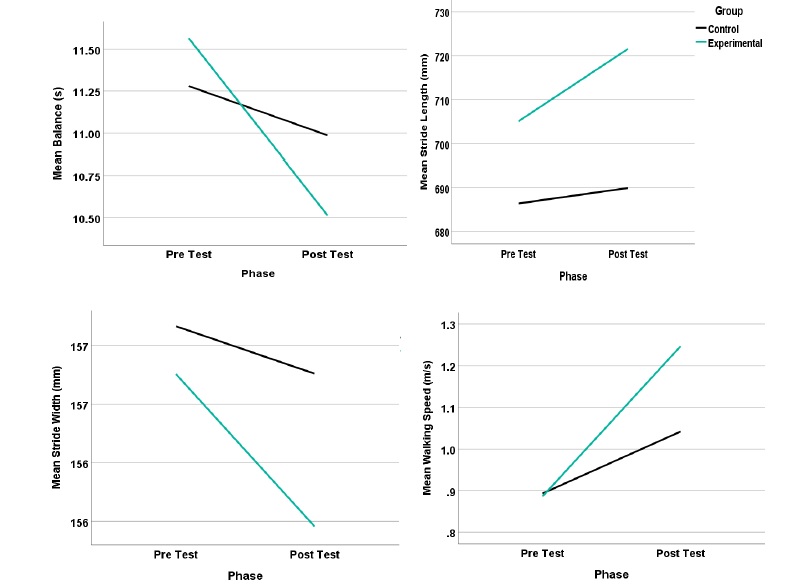
Figure 1. Mean values of stride length, stride width, stride speed, and balance factor by groups in pre-test and post-test.
| Variables | Source | df | F | p-value | η2 |
|---|---|---|---|---|---|
| Dynamic balance | Group | 1 | 25.31 | 0.001 | 0.437 |
| Error | 33 | - | - | - | |
| Step length | Group | 1 | 9.71 | 0.004 | 0.227 |
| Error | 33 | - | - | - | |
| Step width | Group | 1 | 29.87 | 0.002 | 0.475 |
| Error | 33 | - | - | - | |
| Walking speed | Group | 1 | 10.83 | 0.003 | 0.247 |
| Error | 33 | - | - | - |
Discussion
Falls are among the leading causes of injury, disability, and loss of independence in older adults, with impairments in gait and balance representing major contributors to this risk. Although a variety of exercise interventions have been investigated to reduce fall risk, relatively few studies have specifically examined the effects of TRX suspension training on gait kinematics and dynamic balance in older adults. Therefore, the present study sought to address this gap by evaluating the effects of a six-week TRX training program on these outcomes in healthy women aged 55–75 years. The findings demonstrated that participants who completed the TRX training program exhibited significant improvements in dynamic balance, stride length, stride width, and gait speed compared with those in the control group. These results suggest that TRX suspension training is an effective intervention for improving functional mobility and gait performance and may help reduce the risk of falls in older adults.
One of the principal findings of the present study was a significant reduction in Timed Up and Go (TUG) test completion time following the TRX training program, indicating improved dynamic balance and functional mobility. This finding is consistent with current theories of motor control, which propose that dynamic balance depends on the neuromuscular system's ability to adapt to environmental changes rapidly. TRX suspension training uniquely challenges this system by introducing controlled instability, thereby promoting core muscle activation, enhancing postural control, and improving neuromuscular coordination [ 35 ].
Previous studies have suggested that multicomponent exercise programs, which simultaneously target muscle strength, proprioception, reaction time, and motor coordination, provide greater benefits for balance than single-component interventions. Owing to its unstable and multiplanar exercise environment, TRX suspension training has been shown to facilitate neuromuscular adaptations that improve balance and functional performance—for example, Aslani et al. [ 36 ] reported significant improvements in static, dynamic, and functional balance among middle-aged men following an eight- week TRX training program. Similarly, Jiménez- García et al. [ 37 ] demonstrated that TRX suspension training effectively improved balance in older adults. These findings are consistent with the present study, which demonstrated significant improvements in dynamic balance and gait kinematic parameters following six weeks of TRX training. Collectively, these findings support the use of TRX suspension training as an effective intervention to enhance functional mobility, improve gait performance, and reduce the risk of falls in older adults.
Additionally, the present study demonstrated significant increases in stride length and walking speed, accompanied by a reduction in stride width in the experimental group. These changes are recognized as important indicators of improved gait efficiency and a reduced risk of falls in older adults. The observed improvements are consistent with the principles of motor adaptation and motor unit plasticity.
Motor adaptation refers to the nervous system's ability to modify motor output in response to changes in environmental conditions or task demands, thereby enhancing movement efficiency, coordination, and functional performance [ 38 ]. This mechanism is particularly relevant to functional training programs, in which varied and progressively challenging movements promote adaptive changes in motor control strategies and movement execution [ 39 ].
Furthermore, motor unit plasticity refers to training- induced changes in motor unit behavior, including increased motor unit firing frequency, enhanced synchronization, and greater force-generating capacity following resistance training. These neural adaptations improve muscle activation patterns, intermuscular coordination, and movement efficiency, all of which are essential for maintaining dynamic balance and an efficient gait pattern [ 40 , 41 ].
Since TRX suspension training combines resistance- based exercises with unstable, multiplanar movement patterns, it likely promotes greater recruitment of fast- twitch motor units, enhances intermuscular coordination, and improves neuromuscular responsiveness. These neuromuscular adaptations may contribute to more stable, efficient, and confident gait patterns, thereby supporting the theoretical frameworks of motor adaptation and motor unit plasticity.
The observed reduction in stride width may be attributed to improvements in lower-extremity muscle strength, particularly in the hip abductor muscles, which play a critical role in maintaining mediolateral stability during gait. In the present study, the TRX functional training program was designed to require participants to perform movements on an unstable suspension system, thereby continuously challenging dynamic postural control. Exercising under unstable conditions requires continuous adjustments in body position to maintain balance, thereby increasing neuromuscular system activation and improving postural control.
These adaptations may enhance neuromuscular coordination and improve the integration of visual, vestibular, and proprioceptive sensory inputs, all of which are essential for maintaining dynamic balance during gait. Consequently, the TRX training program may improve motor control by increasing the efficiency of sensory feedback, facilitating more effective neuromuscular responses to postural perturbations, strengthening proprioceptive function, and increasing lower-extremity muscle strength [ 18 , 21 ]
From a neurophysiological perspective, these findings are consistent with the principles of neuroplasticity. Evidence suggests that regular physical exercise can induce both structural and functional adaptations within the neural circuits responsible for motor control. TRX suspension training may promote neuroplastic changes by enhancing cortical organization, improving synaptic efficiency, and strengthening neural pathways involved in motor control, thereby facilitating more effective motor planning, postural reflexes, and anticipatory postural adjustments [ 42 ]. These neural adaptations are particularly important in older adults, as age-related declines in sensory processing, neuromuscular function, and motor execution are major contributors to impaired mobility and an increased risk of falls.
The older adult population in our country is growing rapidly, while increasing industrialization and the mechanization of daily activities have substantially reduced physical activity across the population. As a result, physical inactivity has become a significant concern among older adults, contributing to numerous health-related problems. Impaired balance and an increased risk of falls are among the most common challenges faced by this population.
Several limitations should be considered when interpreting these findings. First, the present study included only healthy women aged 55–75 years. Therefore, the findings may not be generalizable to other populations, such as older men or individuals with specific medical conditions. Future studies are warranted to investigate the effects of TRX training in more diverse populations.
In addition, this study focused primarily on the kinematic assessment of gait and balance parameters. To achieve a more comprehensive understanding of the physiological mechanisms underlying the observed improvements, future research should incorporate complementary assessment tools, such as force platforms and neuromuscular evaluation techniques, which may provide further insight into the biomechanical and neuromuscular processes associated with TRX training.
Conclusion
The findings of the present study indicate that six weeks of TRX suspension training can significantly improve dynamic balance and selected gait kinematic parameters, including stride length, stride width, and gait speed, in healthy women aged 55–75 years. These improvements suggest that TRX training may enhance functional mobility and gait performance through adaptations in neuromuscular coordination, postural control, and sensorimotor integration. Given the importance of maintaining mobility and balance in older adulthood, TRX suspension training may represent a practical and multifaceted exercise approach for promoting functional independence and potentially reducing fall risk. However, further research involving larger and more diverse populations and incorporating biomechanical and neuromuscular assessments is warranted to clarify the mechanisms underlying these adaptations.
Acknowledgment
The authors sincerely thank all participants for their valuable cooperation and commitment throughout the study. The authors also acknowledge the staff and colleagues of the Faculty of Sport Sciences at Shahid Bahonar University of Kerman for providing the facilities and technical support required for data collection.
Author Contributions
All authors made substantial contributions to the study's conception and design, data collection, data management, analysis, and interpretation of the findings. All authors participated in drafting and critically revising the manuscript for important intellectual content, approved the final version, and agreed to its submission for publication.
Funding
This research received no external funding and was supported by the internal resources of the authors' affiliated institutions.
Conflict of Interest
The authors declare that they have no conflicts of interest related to this study or the publication of this manuscript.
References
- Saxon SV, Etten MJ, Perkins EA. Physical change and aging: A guide for helping professions. Springer Publishing Company; 2021 Sep 26.
- Riley MW. Aging, health, and social change: An overview. The aging dimension: Lawrence Erlbaum Associates, Inc; 1 987; 1-14.
- Westwood S, Carey N. Ageing with physical disabilities and/or long-term health conditions. Ageing, Diversity and Equality: Routledge; 2018; 225-244.
- Campbell MD, Djukovic D, Raftery D, Marcinek DJ. Age‐ related changes of skeletal muscle metabolic response to contraction are also sex‐dependent. The Journal of Physiology. 2025; 603(1):69-86.
- Jain SK, Chrisfield K. Geriatric Gait and Balance Disorders.
- Osoba MY, Rao AK, Agrawal SK, Lalwani AK. Balance and gait in the elderly: A contemporary review. Laryngoscope investigative otolaryngology. 2019; 4(1):143-53.
- Cebolla EC, Rodacki AL, Bento PC. Balance, gait, functionality and strength: comparison between elderly fallers and non-fallers. Brazilian journal of physical therapy. 2015 Apr 27; 19(2):146-51.
- Ekvall Hansson E, Valkonen E, Olsson Möller U, Chen Lin Y, Magnusson M, Fransson P-A. Gait flexibility among older persons significantly more impaired in fallers than non-fallers— a longitudinal study. International journal of environmental research and public health. 2021; 18(13):1-13.
- Lipsitz LA, Lough M, Niemi J, Travison T, Howlett H, Manor B. A shoe insole delivering subsensory vibratory noise improves balance and gait in healthy elderly people. Archives of physical medicine and rehabilitation. 2015; 96(3):432-439.
- Silva J, Atalaia T, Abrantes J, Aleixo P. Gait Biomechanical Parameters Related to Falls in the Elderly: A Systematic Review. Biomechanics. 2024; 4(1):165-218.
- Verghese J, Holtzer R, Lipton RB, Wang C. Quantitative gait markers and incident fall risk in older adults. Journals of Gerontology Series A: Biomedical Sciences and Medical Sciences. 2009; 64(8):896-901.
- Hausdorff JM, Rios DA, Edelberg HK. Gait variability and fall risk in community-living older adults: a 1-year prospective study. Archives of physical medicine and rehabilitation. 2001; 82(8):1050-1056.
- Kakara R. Nonfatal and fatal falls among adults aged≥ 65 years—United States, 2020–2021. MMWR Morbidity and Mortality Weekly Report. 2023; 72(35):938-943.
- Korenhof S, van Grieken A, Franse C, Tan SS, Verma A, Alhambra T, et al. The association of fear of falling and physical and mental Health-Related Quality of Life (HRQoL) among community-dwelling older persons; a cross-sectional study of Urban Health Centres Europe (UHCE). BMC geriatrics. 2023; 23(1):291-299.
- Moradi M, Eskandari Z, Mirmoezzi M, Lashgari M. [Effect of TRX Suspension Training on Balance, Mobility, Lower Limb Muscle Strength, and Fear of Falling in Older Men]. The Scientific Journal of Rehabilitation Medicine. 2023; 12(5):868-879.
- Fragala MS, Cadore EL, Dorgo S, Izquierdo M, Kraemer WJ, Peterson MD, et al. Resistance training for older adults: position statement from the national strength and conditioning association. The Journal of Strength and Conditioning Research. 2019; 33(8):2019-2052.
- Keating CJ, Cabrera-Linares JC, Párraga-Montilla JA, Latorre-Román PA, Del Castillo RM, García-Pinillos F. Influence of resistance training on gait and balance parameters in older adults: A systematic review. International journal of environmental research and public health. 2021; 18(4):1759-1771.
- Farsi A, Abdoli B, Baraz P. Effect of balance, strength, and combined training on the balance of the elderly women. Iranian Journal of Ageing. 2015; 10(3):54-61.
- Manini T, Marko M, VanArnam T, Cook S, Fernhall B, Burke J, Ploutz-Snyder L. Efficacy of resistance and task-specific exercise in older adults who modify tasks of everyday life. The Journals of Gerontology Series A: Biological Sciences and Medical Sciences. 2007; 62(6):616-623.
- Liang Y, Wang R, Jiang J, Tan L, Yang M. A randomized controlled trial of resistance and balance exercise for sarcopenic patients aged 80–99 years. Scientific Reports. 2020; 10(1):1-7.
- Farsi A, Ashayeri H, Mohammadzadeh S. The Effect of Six Weeks Balance Training Program on Kinematic of Walking in Women Elderly People. Salmand: Iranian Journal of Ageing. 2015; 9(4):278-287.
- Mohammad Ali Nasab Firouzjah E, Farnian L. The Effect of a Fall Proof Training on Balance and Fear of Falling in Older Women. The Scientific Journal of Rehabilitation Medicine. 2023; 11(6):988-1001.
- Beauchet O, Fantino B, Allali G, Muir S, Montero-Odasso M, Annweiler C. Timed Up and Go test and risk of falls in older adults: a systematic review. The journal of nutrition, health and aging. 2011; 15:933-938.
- Shumway-Cook A, Brauer S, Woollacott M. Predicting the probability for falls in community-dwelling older adults using the Timed Up & Go Test. Physical therapy. 2000; 80(9):896-903.
- Hunter GR, McCarthy JP, Bamman MM. Effects of resistance training on older adults. Sports medicine. 2004; 34:329-48.
- Persch LN, Ugrinowitsch C, Pereira G, Rodacki AL. Strength training improves fall-related gait kinematics in the elderly: a randomized controlled trial. Clinical biomechanics. 2009; 24(10):819-825.
- Mattos D, Latash ML, Park E, Kuhl J, Scholz J. Unpredictable elbow joint perturbation during reaching results in multijoint motor equivalence. Journal of neurophysiology. 2011; 106(3):1424-1436.
- Sadeghi H, Norouzi H, Karimi Asl A, Montazer M. [The six- week training program on static and dynamic balance performance in older men]. Ageing Iran J. 2010; 3(8):565-571.
- Podsiadlo D, Richardson S. The timed “Up and Go”: a test of basic functional mobility for frail elderly persons. Journal of the American geriatrics Society. 1991; 39(2):142-148.
- Rockwood K, Awalt E, Carver D, MacKnight C. Feasibility and measurement properties of the functional reach and the timed up and go tests in the Canadian study of health and aging. The journals of gerontology Series A, Biological sciences and medical sciences. 2000; 55(2):M70-M73.
- Wang CY, Olson SL, Protas EJ. Test-retest strength reliability: hand-held dynamometry in community-dwelling elderly fallers. Archives of physical medicine and rehabilitation. 2002; 1;83(6):811-815.
- Winter DA. Biomechanics and motor control of human movement. Hoboken, NJ: wiley; 2009 Sep 17.
- Martin ST, Kessler M. Neurologic interventions for physical therapy-e-book. Elsevier Health Sciences; 2026 Feb 10.
- Cohen JW. Statistical Power Analysis for the Behavioral Sciences. 2nd end ed: Hikadale,NJ: Lawrence Erlbaum Assosiates; 1988.
- Behm D, Colado JC. The effectiveness of resistance training using unstable surfaces and devices for rehabilitation. International journal of sports physical therapy. 2012 Apr; 7(2):226-241.
- Aslani M, Kalantariyan M, Minoonejad H. Effect of functional training with TRX on the balance of middle-aged men. The Scientific Journal of Rehabilitation Medicine. 2018; 7(4):80-89.
- Jiménez-García JD, Hita-Contreras F, de la Torre-Cruz M, Fábrega-Cuadros R, Aibar-Almazán A, Cruz-Díaz D, et al. High-intensity interval training using TRX lower-body exercises improve the risk of falls in healthy older people. Journal of aging and physical activity. 2019; 27(3):325-333.
- Bastian AJ. Understanding sensorimotor adaptation and learning for rehabilitation. Current opinion in neurology. 2008; 21(6):628-633.
- Carroll TJ, Riek S, Carson RG. Neural adaptations to resistance training: implications for movement control. Sports medicine. 2001; 3-1:829840.
- Gabriel DA, Kamen G, Frost G. Neural adaptations to resistive exercise: mechanisms and recommendations for training practices. Sports medicine. 2006; 36:133-149.
- Del Vecchio A, Enoka RM, Farina D. Specificity of early motor unit adaptations with resistive exercise training. The Journal of Physiology. 2024; 602(12):2679-2688.
- Voelcker-Rehage C, Godde B, Staudinger UM. Cardiovascular and coordination training differentially improve cognitive performance and neural processing in older adults. Fronties in Human Neuroscience. 2011; 5:1-12.

