
Introduction
Low back pain (LBP) is one of the most prevalent musculoskeletal disorders in both developed and developing countries and imposes a substantial socioeconomic burden on individuals and society. In the United States, the direct cost of LBP was estimated at US$34 billion in 2010. When indirect costs, such as lost workplace productivity, are included, the total economic burden increases to approximately US$200 billion [ 1 , 2 ]. After the common cold, LBP is the second most common reason for physician visits, with approximately 18 million people seeking medical care annually [ 2 ]. In Iran, the lifetime prevalence of LBP has been reported to be 51%, indicating that approximately half of the population has experienced LBP at least once during their lifetime [ 3 ].
Current treatment approaches for LBP, including nonsteroidal anti-inflammatory drugs (NSAIDs), opioids for mild pain, spinal fusion surgery, and epidural steroid injections for moderate to severe pain, have shown limited effectiveness in the management of chronic LBP [ 4 ]. Furthermore, many of these treatments are associated with undesirable side effects. Consequently, there is a growing need to re-evaluate low-risk and cost-effective nonpharmacological interventions [ 5 ].
The use of chiropractic care as an adjunct to conventional treatment has increased in recent years [ 6 ]. Several studies have reported that patients are more satisfied with chiropractic care than with conventional medical care [ 7 ]. Chiropractic care is now widely used to manage back pain. Its therapeutic effects on LBP are thought to be mediated primarily through neurophysiological mechanisms involving the spinal cord, although supraspinal and peripheral mechanisms have also been proposed [ 8 ].
In its modern form, chiropractic was established by Daniel David Palmer in the United States in 1895 [ 9 ]. Chiropractic interventions are performed primarily on the spine. However, they have also been reported to be effective for conditions affecting other regions, including the extremities, neck, and craniofacial region [ 10 , 11 ]. In Denmark, at least one-third of patients with LBP initially seek chiropractic care [ 12 ]. In the United States, approximately 7.5% of the population uses chiropractic services annually, accounting for more than 190 million visits each year [ 13 ].
Several studies have reported higher levels of patient satisfaction with chiropractic care than with other therapeutic modalities [ 14 - 16 ]. Ernest et al. conducted a systematic review comparing the effects of chiropractic care with those of medication, physical therapy, exercise programs, sham interventions, and no treatment for LBP. They reported that chiropractic care was more effective than physiotherapy, sham interventions, and no treatment but less effective than conventional medical care [ 17 ]. A systematic review and meta-analysis of chronic nonspecific LBP in Iran also suggested that chiropractic care may be effective; however, additional high-quality studies are needed to strengthen the evidence [ 18 ]. Furthermore, chiropractic care has been shown to reduce pain severity and disability in patients with LBP [ 19 , 20 ]. Chiropractic manipulation may also reduce gabapentin prescriptions and opioid use among patients with LBP [ 21 , 22 ]. Some studies have reported superior outcomes with chiropractic manipulation compared with physical therapy [ 23 ].
Today, the World Federation of Chiropractic has member organizations in 95 countries, including Iran. The World Health Organization (WHO) defines chiropractic as “a healthcare profession concerned with the diagnosis, treatment, and prevention of disorders of the neuromusculoskeletal system and the effects of these disorders on general health.” Given the high prevalence of LBP and the growing number of affected individuals, further studies are needed to evaluate the effectiveness of chiropractic interventions. To the best of our knowledge, few clinical studies have been conducted on this topic in Iran [ 24 , 25 ].
When evidence-based interventions have been identified, alternative research designs are needed to evaluate their effectiveness in real-world clinical settings. Quasi-experimental designs are increasingly being used to address this need [ 26 ]. Therefore, the present quasi-experimental study aimed to evaluate the effectiveness of chiropractic care in patients with chronic LBP.
Methods
Study Design, Participants, and Sample Size
This study was approved by the Ethics Committee of Shiraz University of Medical Sciences (IR.SUMS.REC.1399.917). Written informed consent was obtained from all participants before enrollment.
This quasi-experimental study included patients with LBP who were referred to private chiropractic clinics for their first chiropractic consultation and had no pathological abnormalities other than those involving the lumbosacral spine. The inclusion criteria were: (1) age ≥18 years; (2) mechanical LBP lasting more than three months; and (3) residence in Fars Province. The exclusion criteria were nonsomatic LBP, the presence of comorbidities that could affect the treatment prognosis, pregnancy, receipt of chiropractic treatment within the previous three months, contraindications to spinal manipulation (including coagulation disorders or the use of anticoagulant medications), drug addiction, and lack of telephone access.
The sample size was determined based on the study by Eklund et al. Using the sample size calculation formula for quasi-experimental studies and assuming a type I error of 5% (α = 0.05) and a type II error of 20% (β = 0.20), the required sample size was estimated to be 100 participants [ 27 ].
Data Collection and Questionnaires
Data were collected at two time points: baseline (the first visit) and eight weeks after treatment. Information was obtained using several questionnaires: the first questionnaire collected demographic characteristics, the duration of LBP, and a family history of LBP.
Magnetic resonance imaging (MRI) was performed using a 3-Tesla superconducting scanner (Skyra version – Syngo MR E11, software NUMARIS/4.1, Siemens Healthineers, Erlangen, Germany) with a spinal coil (24) (1365). The MRI protocol included the following pulse sequences:
1.Sagittal T2-weighted turbo spin-echo: repetition time (TR), 3500 ms; echo time (TE), 95 ms; echo train length, 31; section thickness, 4 mm; field of view (FOV), 280 × 280 mm; matrix size, 240 × 256; one signal acquisition.
2.Sagittal T1-weighted spin-echo: repetition time (TR), 600 ms; echo time (TE), 14 ms; echo train length, 15; section thickness, 4 mm; field of view (FOV), 280 × 280 mm; matrix size, 256 × 320; one signal acquisition.
3.Axial T2-weighted turbo spin-echo at the lumbar intervertebral disc levels: repetition time (TR), 3800 ms; echo time (TE), 16.4 ms; echo train length, 17; section thickness, 4 mm; field of view (FOV), 200 × 200 mm; matrix size, 272 × 320; one signal acquisition.
Participants underwent MRI within one week before the baseline visit. The lumbosacral spine MRIs were evaluated, and participants were classified into three categories according to the severity of intervertebral disc degeneration: mild degeneration (Grade II), moderate degeneration (Grade III), and severe degeneration (Grades IV and V) [ 28 ].
The following three questionnaires were used to evaluate the effectiveness of the intervention:
Roland–Morris Disability Questionnaire (RMDQ):
Disability related to LBP was assessed using the standard Roland–Morris Disability Questionnaire (RMDQ) before and after the intervention. The RMDQ is a patient-administered, self-report instrument consisting of 24 items. Scores range from 0 (no disability) to 24 (severe disability), with higher scores indicating greater disability. Patients were instructed to mark the statements that described the impact of their LBP during the previous 24 hours. The RMDQ has demonstrated excellent psychometric properties, with reported Cronbach's α values ranging from 0.84 to 0.96 and test–retest reliability coefficients ranging from 0.83 to 0.90 [ 29 ]. The validity and reliability of the Persian version of the RMDQ were confirmed by Mousavi et al. in 2006 [ 30 ].
The RMDQ was selected for the present study because of its high responsiveness to changes in disability among patients with LBP. Moreover, it has been used more frequently than other comparable disability questionnaires in clinical trials involving patients with LBP [ 31 , 32 ]. Participants completed the RMDQ at baseline and again 8 weeks after treatment initiation. Based on previous studies, a 30% reduction in the RMDQ score (equivalent to approximately 7 points) was considered a clinically meaningful improvement [ 33 ].
Numerical Rating Scale (NRS)
The Numerical Rating Scale (NRS) is a patient- administered, self-report instrument used to assess pain intensity. Participants were asked to rate their average LBP intensity over the previous week on an 11-point scale from 0 (no pain) to 10 (the worst pain imaginable). The NRS was administered at baseline and again 8 weeks after treatment initiation. Scores of 0, 1–3, 4–6, and 7–10 were categorized as no pain, mild pain, moderate pain, and severe pain, respectively.
The NRS has demonstrated excellent psychometric properties and has been widely used in randomized controlled trials (RCTs). It is considered a valid and reliable instrument for assessing pain intensity [ 34 ]. Child et al. evaluated the responsiveness of the NRS for detecting changes in LBP and confirmed its responsiveness in 2005 [ 35 ]. The Persian version of the NRS was also evaluated by Forutani et al. and was found to be valid and reliable for use in Iran [ 36 ].
Global Rating of Change (GRC)
The Global Rating of Change (GRC) questionnaire was administered during the follow-up assessment. This patient-administered, self-report instrument evaluates patients' perceived change in LBP following the intervention with a single question assessing overall improvement. Participants were asked to rate their perceived improvement in LBP eight weeks after treatment initiation. The validity and reliability of the Persian version of the GRC questionnaire were confirmed by Foroutani et al. in 2018 [ 36 ].
Intervention
The intervention consisted of manual therapy techniques emphasizing spinal adjustment, manipulation, mobilization, and soft tissue techniques. It also included rehabilitation exercises, attention to psychosocial aspects of patient care, education on spinal health, and instruction on proper posture. Chiropractic care was provided by three licensed chiropractors over six treatment sessions conducted on alternate days during two weeks. The overall treatment protocol was standardized across all participants, although the specific techniques applied during each approximately 20-minute session were tailored to each patient's clinical condition, as follows:
1. The Activator is a handheld instrument used to deliver controlled mechanical impulses to specific spinal segments. During this stage, patients underwent leg-length assessment according to the Activator clinical protocol to identify vertebral dysfunction. When vertebral dysfunction requiring treatment was identified, the Activator instrument was applied to the transverse process of the affected vertebra to deliver a therapeutic adjustment.
2. The drop table is equipped with movable cervical, lumbar, and pelvic sections and is primarily used to facilitate the correction of pelvic and spinal dysfunction.
3. The ArthroStim resembles the Activator but delivers higher-frequency mechanical impulses and is used to facilitate spinal alignment and stimulate the paraspinal muscles.
4. The flexion–distraction table produces controlled flexion and extension movements to reduce muscle spasm and facilitate rehydration of the intervertebral discs.
5. The final stage involved manual spinal manipulation to restore spinal alignment.
Participants were advised to avoid activities that could aggravate their LBP or contribute to symptom recurrence. The follow-up at the second assessment point was conducted by telephone.
Statistical Analysis
The collected data were analyzed using IBM SPSS Statistics for Windows, Version 22.0 (IBM Corp., Armonk, NY, USA). Categorical variables are presented as frequencies and percentages, whereas continuous variables are presented as the mean ± standard deviation (SD).
Comparisons between quantitative and qualitative variables were performed using the independent- samples t test and the chi-square test, respectively, as appropriate. In addition, linear and logistic regression analyses were conducted to identify factors associated with treatment outcomes, including age, sex, marital status, occupation, educational level, place of residence, economic status, body mass index (BMI), duration of LBP, and MRI findings. Independent- samples t test, one-way analysis of variance (ANOVA), paired t test, and the chi-square test were used for group comparisons, as appropriate. A two- tailed P value <0.05 was considered statistically significant.
Results
Participant Characteristics
A total of 187 patients with chronic LBP were recruited between 2019 and 2020. Of these, 37 patients who had neck pain in addition to LBP were excluded. Consequently, 141 patients were included in the final analysis (Figure 1).
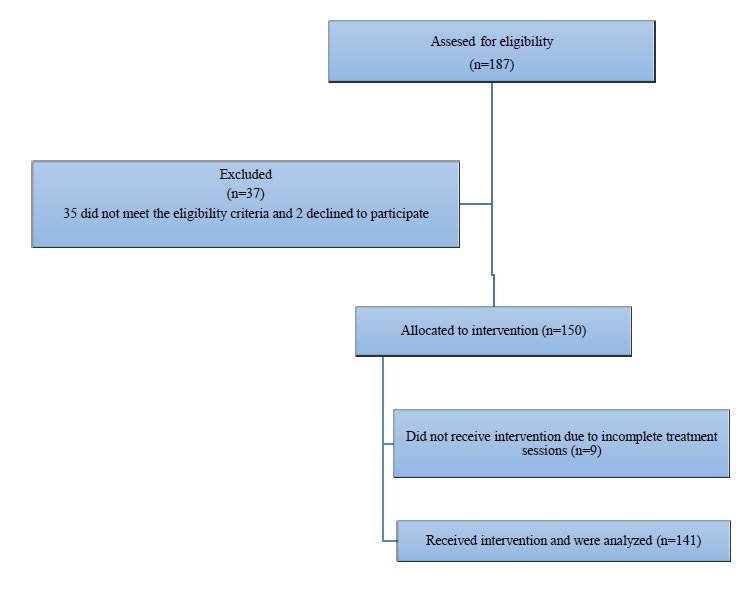
Figure 1. The study Flow Chart
The mean age of the participants was 40.18 ± 10.42 years, and 40 participants (28.4%) were male. No significant sex difference was observed in the distribution of MRI findings (mild, moderate, and severe) (P = 0.930). The duration of LBP was also compared between male and female participants. The mean duration of LBP was longer among females (63.60 ± 45.91 months) than among males (39.35 ± 38.33 months).
Effect of the Intervention on Disability Based on the RMDQ
The mean change in RMDQ score before and after the intervention did not differ significantly according to participants' demographic characteristics, except for occupation (P = 0.004). Unemployed participants demonstrated the greatest improvement in disability, with a mean reduction in the RMDQ score of 9.32 ± 5.94, compared with 6.98 ± 5.10 among employed participants (Table 1).
| Variables | Subgroups | Frequency N (%) | Before Mean ± SD | After Mean ± SD | P-value* | P-value** |
|---|---|---|---|---|---|---|
| Age (years) | ≤40 | 40 (28.4) | 12.25 ± 4.69 | 6.49 ± 5.16 | <0.001 | 0.467 |
| >40 | 101 (71.6) | 14.29 ± 4.96 | 9.1 ± 5.92 | <0.001 | ||
| Gender | Male | 40 (28.4) | 10.95 ± 4.89 | 6.65 ± 5.75 | <0.001 | 0.061 |
| Female | 101 (71.6) | 13.88 ± 4.65 | 7.85 ± 5.53 | <0.001 | ||
| Marital status | Single | 21 (14.9) | 10.95 ± 4.44 | 5.57 ± 4.53 | <0.001 | 0.875 |
| Married | 120 (85.1) | 13.42 ± 4.88 | 7.85 ± 5.71 | <0.001 | ||
| Education level | Diploma or below | 67 (47.5) | 14.89 ± 4.46 | 9.04 ± 5.85 | <0.001 | 0.479 |
| Academic | 74 (52.5) | 11.38 ±4.66 | 6.12 ± 5.00 | <0.001 | ||
| Occupation | Employed | 68 (48.2) | 11.82 ± 4.50 | 6.98 ± 5.10 | <0.001 | 0.004 |
| Unemployed | 26 (18.4) | 14.04 ± 4.60 | 5.61 ± 5.35 | <0.001 | ||
| Homemaker | 47 (33.3) | 14.28 ± 4.50 | 9.32 ± 5.94 | <0.001 | ||
| Residence | Small city | 57 (40.4) | 12.88 ± 5.38 | 7.37 ± 5.80 | <0.001 | 0.937 |
| Large city | 84 (59.6) | 13.05 ± 4.08 | 7.72 ± 5.32 | <0.001 | ||
| Economic status | Lower than intermediate | 34 (24.1) | 14.35 ± 4.76 | 8.62 ± 6.47 | <0.001 | 0.426 |
| Intermediate | 93 (66.0) | 12.67 ± 4.97 | 7.44 ± 5.41 | <0.001 | ||
| Higher than intermediate | 14 (9.9) | 12.40 ± 4.35 | 5.40 ± 4.04 | <0.001 | ||
| BMI | Normal | 48 (34.0) | 11.97 ± 4.39 | 6.68 ± 5.00 | <0.001 | 0.106 |
| Overweight | 66 (46.0) | 13.40 ± 5.23 | 8.42 ± 5.88 | <0.001 | ||
| Obese | 27 (19.1) | 14.07 ± 4.65 | 6.74 ± 5.74 | <0.001 | ||
| Duration of LBP (months) | 6-12 | 38 (27.0) | 12.74 ± 4.90 | 6.50 ± 5.46 | <0.001 | 0.335 |
| 13-48 | 37 (26.2) | 13.12 ± 4.36 | 6.86 ± 4.71 | <0.001 | ||
| 49-95 | 31 (22.0) | 11.93 ± 5.74 | 7.48 ± 6.05 | <0.001 | ||
| 96-180 | 35 (24.8) | 14.31 ± 4.48 | 9.31 ± 6.00 | <0.001 | ||
| MRI | Mild | 108 (76.6) | 12.73 ± 4.80 | 7.20 ± 5.36 | <0.001 | 0.943 |
| Moderate | 26 (18.4) | 14.23 ± 5.39 | 8.81 ± 6.64 | <0.001 | ||
| Severe | 7 (5.0) | 13.57 ± 3.82 | 7.43 ± 5.22 | <0.001 | ||
| * paired t-test; **repeated measure ANOVA. | ||||||
| N: number, SD: standard deviation, BMI: body mass index, LBP: low back pain, MRI: magnetic resonance imaging | ||||||
Before the intervention, the mean RMDQ score was 13.50 ± 4.89, which decreased to 7.51 ± 5.60 after the intervention (P < 0.001) (Figure 2).
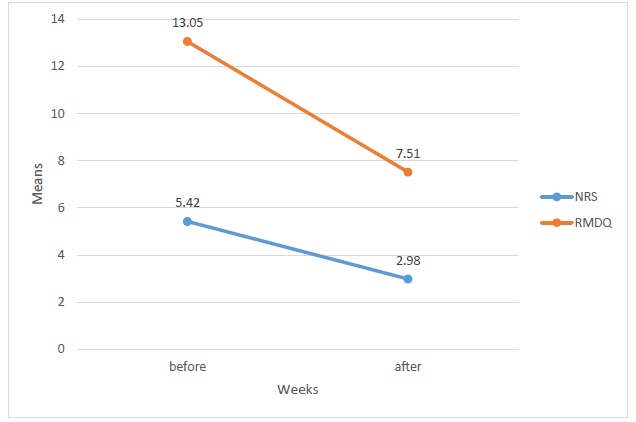
Figure 2. Mean Roland-Morris disability questionnaire) RMDQ ((disability) and Numerical Rating Scale) NRS ((pain intensity) scores before and after the intervention.
Effect of the Intervention on Pain Intensity Based on the NRS
The mean ± SD NRS pain intensity score was 5.42 ± 6.09 before the intervention and decreased to 2.98 ± 1.64 after the intervention (P < 0.001) (Figure 2). The mean NRS score was significantly correlated with all demographic and clinical characteristics before and after the intervention. However, no significant difference was observed among the subgroups in this regard (Table 2).
| Variables | Subgroups | NRS Before (mean ± SD) | NRS After (mean ± SD) | P-value* | P-value |
|---|---|---|---|---|---|
| Age (years) | ≤40 | 5.39 ± 0.70 | 2.85 ± 1.78 | <0.001 | 0.336 |
| >40 | 5.45 ± 0.69 | 3.18 ± 1.39 | <0.001 | ||
| Gender | Male | 5.12 ± 0.68 | 3.02 ± 1.67 | <0.001 | 0.122 |
| Female | 5.53 ± 0.67 | 2.96 ± 1.64 | <0.001 | ||
| Marital status | Single | 5.09 ± 0.77 | 2.62 ± 1.46 | <0.001 | 0.913 |
| Married | 5.47 ± 0.68 | 3.04 ± 1.67 | <0.001 | ||
| Education level | Diploma or below | 5.66 ± 0.69 | 3.13 ± 1.70 | <0.001 | 0.571 |
| Academic | 5.20 ± 0.64 | 2.84 ± 1.59 | <0.001 | ||
| Occupation | Employed | 5.35 ± 0.66 | 3.05 ± 1.58 | <0.001 | 0.119 |
| Unemployed | 5.19 ± 0.75 | 2.15 ± 1.59 | <0.001 | ||
| Homemaker | 5.64 ± 0.67 | 3.32 ± 1.64 | <0.001 | ||
| Residence | Small city | 5.44 ± 0.71 | 3.04 ± 1.47 | <0.001 | 0.830 |
| Large city | 5.40 ± 0.71 | 2.94 ± 1.76 | <0.001 | ||
| Economic status | Lower than intermediate | 5.65 ± 0.59 | 3.00 ± 1.77 | <0.001 | 0.148 |
| Intermediate | 5.35 ± 0.73 | 3.09 ± 1.62 | <0.001 | ||
| Higher than intermediate | 5.33 ± 0.61 | 2.27 ± 1.39 | <0.001 | ||
| BMI | Normal | 5.31 ± 0.66 | 3.10 ± 1.57 | <0.001 | 0.055 |
| Overweight | 5.44 ± 0.76 | 3.11 ± 1.72 | <0.001 | ||
| Obese | 5.56 ± 0.64 | 2.45 ± 1.53 | <0.001 | ||
| Duration of LBP (Month) | 6-12 | 5.26 ± 0.76 | 2.47 ± 1.60 | <0.001 | 0.423 |
| 13-48 | 5.43 ± 0.65 | 3.00 ± 1.45 | <0.001 | ||
| 49-95 | 5.45 ± 0.72 | 3.29 ± 1.64 | <0.001 | ||
| 96-180 | 5.54 ± 0.66 | 3.23 ± 1.82 | <0.001 | ||
| MRI | Mild | 5.38 ± 0.69 | 2.96 ± 1.61 | <0.001 | 0.951 |
| Moderate | 5.42 ± 0.64 | 2.92 ± 1.72 | <0.001 | ||
| Severe | 6.00 ± 0.82 | 3.43 ± 2.07 | <0.001 | ||
| *repeated measures ANOVA | |||||
| SD: standard deviation, BMI: body mass index, LBP: low back pain, MRI: magnetic resonance imaging | |||||
Effect of the Intervention on LBP Improvement Based on the GRC Questionnaire
The mean ± SD GRC score, representing participants' perceived improvement in LBP, was 56.13 ± 33.03% after the intervention. No significant association was observed between GRC scores and participants' demographic characteristics (Table 3).
| Variables | GRC (Mean ± SD) | P-value* | |
|---|---|---|---|
| Age (years) | ≤40 | 56.98 ± 34.96 | 0.707 |
| >40 | 54.82 ± 30.03 | ||
| Gender | Male | 51.13 ± 35.87 | 0.259 |
| Female | 58.12 ± 31.81 | ||
| Marital status | Single | 61.25 ± 33.44 | 0.576 |
| Married | 56.13 ± 33.41 | ||
| Education level | Diploma or below | 54.48 ± 32.49 | 0.573 |
| Academic | 57.64 ± 33.67 | ||
| Occupation | Employed | 53.75 ± 34.10 | 0.085 |
| Unemployed | 69.04 ± 29.29 | ||
| Homemaker | 52.45 ± 32.32 | ||
| Residence | Small city | 55.35 ± 31.34 | 0.817 |
| Large city | 56.67 ± 34.31 | ||
| Economic status | Lower than intermediate | 55.29 ± 34.38 | 0.674 |
| Intermediate | 55.27 ± 33.18 | ||
| Higher than intermediate | 63.33 ± 30.16 | ||
| BMI | Normal | 55.63 ± 31.70 | 0.205 |
| Overweight | 52.50 ± 34.41 | ||
| Obese | 65.95 ± 31.07 | ||
| MRI | Mild | 56.76 ± 31.80 | 0.916 |
| Moderate | 54.42 ± 36.00 | ||
| Severe | 52.86 ± 44.61 | ||
| *T-test | |||
| , SD: standard deviation, BMI: body mass index, MRI: magnetic resonance imaging | |||
Clinically Significant Effects
Based on the predefined RMDQ cutoff point, chiropractic treatment produced a clinically significant improvement in 88 participants (62%; 95% CI: 50–70). Multivariable logistic regression analysis was performed with clinically significant improvement based on the RMDQ as the dependent variable and economic status, NRS score, and GRC score as independent variables. The results indicated that participants with a higher economic status had 170% higher odds (adjusted OR: 2.7; 95% CI: 1.09–6.51) than those with a lower economic level (Table 4).
| Crude OR (95% confidence interval) | Adjusted OR (95% confidence interval) | |
|---|---|---|
| Higher economic status | 1.9 (1.02-3.55) | 2.67 (1.09-6.51) |
| NRS | 0.04 (0.01-.11) | 0.22 (.62-.79) |
| GRC | 1.05 (1.04-1.07) | 1.05 (1.02-1.07) |
| OR: odds ratio | ||
Discussion
In this study, LBP was assessed using the RMDQ, NRS, and GRC questionnaires before and after chiropractic treatment. The results demonstrated that chiropractic treatment was associated with improvements in disability, pain intensity, and patients' perceived global improvement. However, among the factors investigated, only occupation was significantly associated with treatment outcomes. Specifically, unemployed participants demonstrated greater improvement following the chiropractic intervention.
One possible explanation is that unemployed individuals may have had greater opportunities to rest during and immediately after treatment, which could have facilitated recovery and enhanced treatment outcomes. In contrast, homemakers exhibited the least improvement, possibly because of the physical demands of routine household activities. Therefore, therapists should provide lifestyle and ergonomic recommendations regarding activity modification, home exercise programs, pain self-management strategies, and approaches to maintaining daily roles and responsibilities throughout the recovery process [ 37 ].
Acupuncture and manual therapy are the two nonpharmacological interventions for LBP that are most consistently recommended in clinical practice guidelines [ 38 ]. Although some systematic reviews have not found sufficient evidence supporting the effectiveness of acupuncture, others have reported favorable outcomes [ 39 , 40 ]. Massage therapy has also been shown to provide only short-term benefits for the treatment of LBP [ 41 ].
The results of the present study demonstrated that chiropractic treatment was associated with a significant reduction in the RMDQ score after the intervention (mean difference = 5.54), suggesting that chiropractic may be effective in reducing disability associated with LBP. Similarly, Goertz et al. conducted a study involving 750 patients using the RMDQ and reported a mean reduction of 4.6 points in disability scores following chiropractic treatment among patients with chronic LBP [ 42 ]. Mortensen et al. evaluated the effects of chiropractic care in patients with acute, subacute, and chronic LBP and found that chiropractic treatment was most effective for acute LBP, followed by subacute and chronic LBP [ 43 ].
In the present study, unemployed participants exhibited the greatest reduction in disability compared with employed participants and homemakers. Therefore, occupational demands, ergonomic conditions, and opportunities for adequate rest may influence the therapeutic effectiveness of chiropractic treatment in patients with LBP.
Considering the NRS scores, the mean reduction in pain intensity following the intervention was 2.44 points, which was statistically significant and consistent with the findings of previous studies [ 42 ]. Similarly, Goertz et al. evaluated the effect of chiropractic treatment on chronic LBP using the NRS and reported a significant reduction in pain intensity following the intervention [ 42 ]. Likewise, Brigitte Worth et al. assessed pain intensity using the NRS in 67 patients with LBP who were referred from neurosurgery clinics to chiropractic centers during a 12-month follow-up period. Their findings demonstrated a mean reduction of 3.7 points in pain intensity after chiropractic treatment. Furthermore, pain intensity remained lower from three months to one year after treatment [ 44 ].
Considering the GRC scores in the present study, participants reported a mean perceived improvement of 56.13 ± 33.03% following the chiropractic intervention. Similarly, Brigitte Worth et al. reported sustained improvements in LBP at 1, 3, and 12 months after chiropractic treatment [ 44 ]. Together, these findings suggest that the therapeutic effects of chiropractic treatment may extend beyond the immediate post-treatment period and persist for up to one year. The findings of other studies have also supported the effectiveness of chiropractic as a conservative treatment option for patients with LBP [ 45 , 46 ]. Furthermore, previous studies have shown that workers who initially sought care from a chiropractor were less likely to experience work disability than those who first consulted other healthcare providers [ 47 ].
Weeks et al. conducted a study involving older adults with chronic LBP who used chiropractic care as the first-line treatment during episodes of LBP. Their findings demonstrated reductions in both the overall cost of treatment and the duration of each episode [ 48 ]. Consistent with the findings of the present study, Christine et al. reported that the addition of chiropractic care to usual medical care improved disability and reduced pain intensity in patients with LBP [ 42 , 49 ]. These findings are consistent with current clinical practiceguidelines that recommend nonpharmacological interventions as first-line treatment for LBP. Therefore, greater consideration should be given to chiropractic interventions in the development and updating of future LBP treatment guidelines.
The results of the present study suggest that chiropractic care may play a beneficial role in the management of patients with nonspecific chronic LBP, including those with severe pain and advanced MRI findings. Accordingly, chiropractic may be a useful therapeutic option for patients with mild, moderate, and severe MRI findings, thereby preventing many lumbosacral intervertebral disc surgeries.
This study has several limitations. First, only three questionnaires were used to assess the primary outcomes, whereas secondary outcomes, such as quality of life, were not evaluated. Second, the therapeutic effects were examined only in patients with chronic LBP, limiting the generalizability of the findings to patients with acute or subacute LBP. Third, the follow-up period was limited to eight weeks because of financial constraints. Fourth, because of limited access to patients attending orthopedic clinics, a control group could not be included for comparison. Finally, participants could not be instructed to refrain from receiving other complementary therapies during the study period.
Conclusion
With the increasing acceptance of chiropractic as a complementary therapeutic approach for the management of LBP, its effectiveness should be evaluated through rigorous scientific research. The findings of the present study suggest that chiropractic therapy may be effective in reducing disability and pain intensity in patients with chronic LBP. Because the therapeutic effects were evaluated across different demographic subgroups, these findings suggest that a broad range of patients with chronic LBP may benefit from chiropractic interventions. Therefore, greater consideration should be given to chiropractic interventions in the development and updating of future LBP treatment guidelines.
Acknowledgment
The authors wish to thank Ms. A. Keivanshekouh at the Research Consultation Center (RCC), Shiraz University of Medical Sciences, for her invaluable assistance with editing this manuscript.
Funding
This study was supported by Shiraz University of Medical Sciences.
Authors’ Contributions
Behdokht Aleali: Conception and design, analysis and interpretation of data, drafting the article and reviewing it critically for important intellectual content; and final approval of the version to be published.
Alireza Salehi: Conception and design, analysis and interpretation of data, drafting the article and reviewing it critically for important intellectual content; and final approval of the version to be published.
Yasaman Vazani: Drafting the article and reviewing it critically for important intellectual content; and final approval of the version to be published.
Mohammad Hossein Sharifi: Drafting the article and reviewing it critically for important intellectual content; and final approval of the version to be published.
Saeed Keshavarz: Conception and design, drafting the article and reviewing it critically for important intellectual content; and final approval of the version to be published.
Hossein Molavi Vardanjani: Analysis and interpretation of data; and final approval of the version to be published.
Malihe Sousani: Analysis and interpretation of data
Conflict of Interest
The authors declare that they have no conflicts of interest.
References
- Gaskin DJ, Richard P. The economic costs of pain in the United States. The Journal of Pain. 2012; 13(8):715-24.
- Murray CJL, Lopez AD. Measuring the Global Burden of Disease. New England Journal of Medicine. 2013; 369(5):448-57.
- Mohamad-Zeidi E, Khalaj M, MM N-J. Quality of life in people with low back pain. Iranian Journal of Aging. 2006; 1(2):119-24.
- Machado GC, Maher CG, Ferreira PH, Day RO, Pinheiro MB, Ferreira ML. Non-steroidal anti-inflammatory drugs for spinal pain: a systematic review and meta-analysis. Annals of the rheumatic diseases. 2017; 76(7):1269-78.
- Brummett CM, Waljee JF, Goesling J, Moser S, Lin P, Englesbe MJ, et al. New persistent opioid use after minor and major surgical procedures in US adults. JAMA surgery. 2017; 152(6):e170504-e.
- Balagué F, Mannion AF, Pellisé F, Cedraschi C. Non-specific low back pain. The lancet. 2012; 379(9814):482-91.
- Hurwitz EL. The relative impact of chiropractic vs. medical management of low back pain on health status in a multispecialty group practice. Journal of manipulative and physiological therapeutics. 1994; 17(2):74-82.
- Gevers‐Montoro C, Provencher B, Descarreaux M, Ortega de Mues A, Piché M. Neurophysiological mechanisms of chiropractic spinal manipulation for spine pain. European Journal of Pain. 2021; 25(7):1429-48.
- Singh S, Ernst E. Trick or treatment: The undeniable facts about alternative medicine: WW Norton and Company; 2008.
- Davis PT, Hulbert JR, Kassak KM, Meyer JJ. Comparative efficacy of conservative medical and chiropractic treatments for carpal tunnel syndrome: a randomized clinical trail. Journal of manipulative and physiological therapeutics. 1998; 21(5):317-26.
- Fallon J. The role of the chiropractic adjustment in the care and treatment of 332 children with otitis media. Journal of Clinical Chiropractic Pediatrics. 1997; 2(2):167-83.
- Wolsko PM, Eisenberg DM, Davis RB, Kessler R, Phillips RS. Patterns and perceptions of care for treatment of back and neck pain: results of a national survey. Spine. 2003; 28(3):292-7.
- Barnes PM, Bloom B, Nahin RL. Complementary and alternative medicine use among adults and children: United States, 2007. National health statistics reports. 2008; 12:1-23.
- Carey TS, Garrett J, Jackman A, McLaughlin C, Fryer J, Smucker DR, et al. The outcomes and costs of care for acute low back pain among patients seen by primary care practitioners, chiropractors, and orthopedic surgeons. New England journal of medicine. 1995; 333(14):913-7.
- Cherkin DC, MacCornack FA. Patient evaluations of low back pain care from family physicians and chiropractors. Western Journal of Medicine. 1989; 150(3):351.
- Weigel PA, Hockenberry JM, Wolinsky FD. Chiropractic use in the Medicare population: prevalence, patterns, and associations with 1-year changes in health and satisfaction with care. Journal of manipulative and physiological therapeutics. 2014; 37(8):542- 51.
- Ernst E, Canter PH. Chiropractic spinal manipulation treatment for back pain? A systematic review of randomised clinical trials. Physical therapy reviews. 2003; 8(2):85-91.
- Yeganeh M, Baradaran HR, Qorbani M, Moradi Y, Dastgiri S. The effectiveness of acupuncture, acupressure and chiropractic interventions on treatment of chronic nonspecific low back pain in Iran: A systematic review and meta-analysis. Complementary therapies in clinical practice. 2017; 27:11-8.
- Vining R, Long CR, Minkalis A, Gudavalli MR, Xia T, Walter J, et al. Effects of Chiropractic Care on Strength, Balance, and Endurance in Active-Duty U.S. Military Personnel with Low Back Pain: A Randomized Controlled Trial. The Journal of Alternative and Complementary Medicine. 2020; 26(7):592-601.
- Salas-Fraire O, Rivera-Pérez JA, Guevara-Neri NP, Urrutia- García K, Martínez-Gutiérrez OA, Salas-Longoria K, et al. Efficacy of whole-body cryotherapy in the treatment of chronic low back pain: Quasi-experimental study. Journal of Orthopaedic Science. 2023; 28(1):112-6.
- Trager RJ, Cupler ZA, Srinivasan R, Casselberry RM, Perez JA, Dusek JA. Association between chiropractic spinal manipulation and gabapentin prescription in adults with radicular low back pain: retrospective cohort study using US data. BMJ Open. 2023; 13(7):e073258.
- Acharya M, Chopra D, Smith AM, Fritz JM, Martin BC. Associations between early chiropractic care and physical therapy on subsequent opioid use among persons with low back pain in Arkansas. Journal of Chiropractic Medicine. 2022; 21(2):67-76.
- Treatment of patients with low back pain: a comparison of physical therapy and chiropractic manipulation. Healthcare; 2020: MDPI.
- Rayegani M, Bahrami M, Farjad M, Ahrari M, Valaie N. A comparison of spinal manipulation with physical therapy for treatment of patients with mechanical low back pain. Journal of Babol University of Medical Sciences. 2002; 4(4):26-31.
- Mohseni-Bandpei MA, Critchley J, Staunton T, Richardson B. A prospective randomised controlled trial of spinal manipulation and ultrasound in the treatment of chronic low back pain. Physiotherapy. 2006; 92(1):34-42.
- Siedlecki SL. Quasi-Experimental Research Designs. Clinical Nurse Specialist. 2020; 34(5):198-202.
- Eklund A, Jensen I, Lohela-Karlsson M, Hagberg J, Leboeuf- Yde C, Kongsted A, et al. The Nordic Maintenance Care program: Effectiveness of chiropractic maintenance care versus symptom-guided treatment for recurrent and persistent low back pain—A pragmatic randomized controlled trial. PloS one. 2018; 13(9):e0203029.
- Pfirrmann CW, Metzdorf A, Zanetti M, Hodler J, Boos N. Magnetic resonance classification of lumbar intervertebral disc degeneration. Spine. 2001; 26(17):1873-8.
- Smeets R, Köke A, Lin CW, Ferreira M, Demoulin C. Measures of function in low back pain/disorders: Low Back Pain Rating Scale (LBPRS), Oswestry Disability Index (ODI), Progressive Isoinertial Lifting Evaluation (PILE), Quebec Back Pain Disability Scale (QBPDS), and Roland‐Morris Disability Questionnaire (RDQ). Arthritis care and research. 2011; 63(S11):S158-S73.
- Mousavi SJ, Parnianpour M, Mehdian H, Montazeri A, Mobini B. The Oswestry disability index, the Roland-Morris disability questionnaire, and the Quebec back pain disability scale: translation and validation studies of the Iranian versions. Spine. 2006; 31(14):E454-E9.
- Stratford PW. Using the Roland-Morris Questionnaire to make decisions about individual patients. Physiotherapy Can. 1996; 48:107-10.
- Roland M, Morris R. A study of the natural history of back pain. Part 1: development of a reliable and sensitive measure of disability in low back pain. Spine (Phila Pa 1976). 1983; 8 (2): 141-4.
- Jordan K, Dunn KM, Lewis M, Croft P. A minimal clinically important difference was derived for the Roland-Morris Disability Questionnaire for low back pain. Journal of clinical epidemiology. 2006; 59(1):45-52.
- Jensen MP, Karoly P. Self-report scales and procedures for assessing pain in adults. Handbook of pain assessment. New York, NY, US: The Guilford Press; 1992. p. 135-51.
- Childs JD, Piva SR, Fritz JM. Responsiveness of the numeric pain rating scale in patients with low back pain. Spine. 2005; 30(11):1331-4.
- Foroutani H, Nakhostin Ansari N, Ansari N, Jalaei S. Investigating the responsiveness of the Persian version of functional rating index in patients with chronic non-specific neck pain: brief report. Tehran University Medical Journal TUMS Publications. 2018; 76(7):498-502.
- Shaw WS, Main CJ, Johnston V. Addressing occupational factors in the management of low back pain: implications for physical therapist practice. Physical therapy. 2011; 91(5):777-89.
- Nicol V, Verdaguer C, Daste C, Bisseriex H, Lapeyre É, Lefèvre-Colau M-M, et al. Chronic low back pain: a narrative review of recent international guidelines for diagnosis and conservative treatment. Journal of clinical medicine. 2023; 12(4):1685.
- Giovanardi CM, Gonzalez-Lorenzo M, Poini A, Marchi E, Culcasi A, Ursini F, et al. Acupuncture as an alternative or in addition to conventional treatment for chronic non-specific low back pain: A systematic review and meta-analysis. Integrative Medicine Research. 2023; 12(3):100972.
- Urits I, Wang JK, Yancey K, Mousa M, Jung JW, Berger AA, et al. Acupuncture for the management of low back pain. Current pain and headache reports. 2021; 25:1-10.
- Farber K, Wieland LS. Massage for low-back pain. Explore. 2016; 12(3):215-7.
- Goertz CM, Long CR, Vining RD, Pohlman KA, Walter J, Coulter I. Effect of usual medical care plus chiropractic care vs usual medical care alone on pain and disability among US service members with low back pain: A comparative effectiveness clinical trial. JAMA network open. 2018; 1(1):e180105-e.
- Hare-Mortensen L, Lauridsen H, Grunnet-Nilsson N. The relative responsiveness of 3 different types of clinical outcome measures on chiropractic patients with low back pain. Journal of manipulative and physiological therapeutics. 2006; 29(2):95-9.
- Wirth B, Riner F, Peterson C, Humphreys BK, Farshad M, Becker S, et al. An observational study on trajectories and outcomes of chronic low back pain patients referred from a spine surgery division for chiropractic treatment. Chiropractic and manual therapies. 2019; 27(1):6.
- Rubinstein SM, van Middelkoop M, Assendelft WJ, de Boer MR, van Tulder MW. Spinal manipulative therapy for chronic low‐back pain. Cochrane database of systematic reviews. 2011; 2
- Walker BF, French SD, Grant W, Green S. A Cochrane review of combined chiropractic interventions for low-back pain. Spine. 2011; 36(3):230-42.
- Blanchette M-A, Rivard M, Dionne CE, Hogg-Johnson S, Steenstra I. Association Between the Type of First Healthcare Provider and the Duration of Financial Compensation for Occupational Back Pain. Journal of Occupational Rehabilitation. 2017; 27(3):382-92.
- Weeks WB, Leininger B, Whedon JM, Lurie JD, Tosteson TD, Swenson R, et al. The association between use of chiropractic care and costs of care among older Medicare patients with chronic low back pain and multiple comorbidities. Journal of manipulative and physiological therapeutics. 2016; 39(2):63-75.e2.
- Qaseem A, Wilt TJ, McLean RM, Forciea MA. Noninvasive treatments for acute, subacute, and chronic low back pain: a clinical practice guideline from the American College of Physicians. Annals of internal medicine. 2017; 166(7):514-30.


