
Introduction
Stroke is a major contributor to disability in adults, impairing their ability to engage independently in activities of daily living [ 1 ]. Despite the declining mortality rate associated with stroke, the number of people living with stroke-related functional limitations has increased [ 2 ]. Stroke is a common cause of paresis and motor impairment affecting the trunk and extremities. It has been reported that 70-80% of individuals in the acute phase of stroke experience impaired upper extremity function. This prevalence decreases to 40-50% in the chronic phase. Significant impairment of upper extremity function results in greater dependence on others for activities of daily living and a reduced quality of life [ 3, 4 , 5 ].
The primary objective of rehabilitation interventions for individuals with stroke is to restore optimal participation and independence in various activities [ 6 ]. As mentioned earlier, improving upper extremity function is a crucial aspect of enhancing the independence of stroke survivors [ 7 ]. A comprehensive assessment of upper extremity function is essential for implementing appropriate interventions. In addition, proper assessment is pivotal for evaluating the effectiveness of interventions and providing relevant data for conducting empirical research [ 8 ].
Several assessment tools have been developed to measure upper extremity motor function in stroke survivors, primarily based on motor performance [ 9 ]. Although stroke-related motor deficits primarily affect one side of the body, activities of daily living often require bilateral coordination of the upper extremities, making it important to consider this factor during functional assessments [ 10 ]. Murphy et al. conducted a review that identified six assessment tools as suitable options, with satisfactory psychometric properties and clinical applicability, for evaluating upper-extremity function in individuals with stroke [ 9 ]. The Chedoke Arm and Hand Activity Inventory (CAHAI) is the only upper extremity assessment tool for individuals with stroke that includes items derived from real-life daily activities [ 11 ]. The CAHAI, a 13-item measure of upper extremity performance during bimanual activities, has demonstrated excellent internal consistency (Cronbach’s α = 0.98) and high inter-rater reliability (ICC = 0.98) in patients with stroke [ 12 ]. By incorporating bimanual tasks based on real-life daily activities, this instrument provides clinicians with valuable insights into the functional capabilities of the upper extremities [ 13 ]. The CAHAI-13 has been used in stroke populations and has been translated into several languages, including German, Portuguese, Mandarin, Malay, Tamil, and Hindi [ 13 - 16 ]. Considering the influence of linguistic and cultural factors on the use of the CAHAI-13, this study aimed to translate the CAHAI-13 into Persian and evaluate the psychometric properties of the Persian version in stroke survivors.
Methods
Participants
A total of 105 stroke survivors were recruited for this non-experimental cross-sectional study using a convenience sampling method from four rehabilitation facilities. The sample size for the inter-rater reliability analysis was calculated using the formula n=((Zα/2+Zβ)2⋅(1−ICC)/ (ICC−ICC0)2) and a web-based sample size calculator [ 17 ]. For this calculation, a statistical power of 0.90, a significance level (α) of 0.05, an acceptable intraclass correlation coefficient (ICC) of 0.70, and an expected ICC of 0.90 were assumed [ 12 ]. In addition, a 10% dropout rate was considered.
Inclusion criteria were as follows: (a) first-ever stroke diagnosed by a neurologist according to the International Classification of Diseases, Tenth Revision (ICD-10); (b) age ≥ 18 years; (c) absence of cognitive impairment (Mini-Mental State Examination score > 24) [ 18 ]; (d) ability to communicate, (ability to communicate; (e) absence of neurological, orthopedic, or rheumatologic disorders other than stroke; and (f) no history of upper extremity impairment before stroke.
To evaluate content validity, the Persian version of the CAHAI-13 was provided to 10 occupational therapists who held at least a bachelor's degree and had at least 5 years of experience in stroke rehabilitation. Their expertise was used to evaluate the clarity and relevance of the items. Participants were excluded if they reported pain during the assessments or experienced a recurrent stroke during the interval between assessments.
All participants provided written informed consent. This study was approved by the Ethics Committee of Iran University of Medical Sciences (IR.IUMS.REC.1399.302).
Translation Process
The CAHAI-13 was translated into Persian according to the International Quality of Life Assessment (IQOLA) translation protocol [ 19 ]. First, the CAHAI- 13 (administration instructions and scoring procedure) was translated and culturally adapted from English into Persian by two independent native Persian-speaking translators (forward translation). Second, the two preliminary Persian translations were reviewed and revised by a panel consisting of the translators and the research team to ensure conceptual, idiomatic, semantic, and cultural equivalence. Based on this review, the initial forward-translated version was developed. This version was then back-translated into English by two independent native English-speaking translators familiar with Persian. The two back- translated versions were compared and reviewed during a meeting involving the authors and the translators. The back-translated version was subsequently reviewed by the CAHAI developers and approved. Finally, the final Persian version of the CAHAI-13 was produced.
To evaluate content validity, the Persian version of the CAHAI-13 was administered to 10 occupational therapists experienced in stroke rehabilitation to assess the clarity and relevance of the items. Content validity was evaluated by calculating the Content Validity Ratio (CVR) and the Content Validity Index (CVI) [ 20 ].
Procedures
All participants were assessed using the CAHAI-13, Action Research Arm Test (ARAT), Wolf Motor Function Test (WMFT), and Fugl-Meyer Assessment- Upper Extremity (FMA-UE). All assessments were conducted by an occupational therapist with five years of experience in neurorehabilitation. The order of the assessments was randomized, with a two-minute break between consecutive assessments to minimize the effects of fatigue on participants’ performance.
Thirty-four participants were randomly selected for video recording to evaluate the inter-rater reliability of the CAHAI-13 using a table of random numbers. The recorded videos were independently scored by two occupational therapists who were familiar with the CAHAI-13. In addition, the CAHAI-13 was readministered to all participants after a one-week interval to evaluate test-retest reliability.
Instruments
Chedoke Arm and Hand Activity Inventory-13 (CAHAI-13)
The CAHAI-13 was developed in 2004 to evaluate upper extremity function in stroke survivors. It consists of 13 items that assess arm and hand function during real-life bimanual activities [ 11 ]. Each item is scored on a 7-point scale, ranging from 1 (total assistance) to 7 (complete independence). The total score ranges from 13 to 91, with lower scores indicating poorer upper extremity function. The original CAHAI-13 demonstrated good internal consistency (Cronbach’s α = 0.95) and excellent inter-rater reliability (ICC = 0.98) in a study involving 39 participants. It also showed a strong positive correlation with the Action Research Arm Test (ARAT) (r = 0.93). The approximate administration time is 25 minutes [ 11 , 12 ].
Action Research Arm Test (ARAT)
The ARAT consists of 19 tasks organized into four subscales: grasp, grip, pinch, and gross movement. Each task is scored on a 4-point Likert scale ranging from 0 (no movement) to 3 (movement performed normally). The maximum total score is 57, with higher scores indicating better upper extremity function.
Initially, participants were asked to perform the most difficult task within each subscale. If they completed the task with normal movement, a score of 3 was assigned to that task and to all remaining tasks within the same subscale. If the participant received a score between 0 and 2 on the first task, the subscale's least difficult task was subsequently administered. The estimated administration time ranges from 5 to 15 minutes.
The ARAT has demonstrated excellent test-retest reliability (ICC = 0.99), inter-rater reliability (ICC = 0.98), and intra-rater reliability (ICC = 0.99) in a study involving 20 individuals with stroke [ 21 , 22 ]. The Persian version of the ARAT has also demonstrated excellent inter-rater reliability (ICC = 0.972) [ 23 ].
Wolf Motor Function Test (WMFT)
The WMFT consists of 15 time-based tasks and 2 strength tasks designed to assess a range of upper- extremity movements, from simple to complex. The quality of movement for each time-based task is scored on a 6-point scale ranging from 0 (does not attempt to use the most affected upper extremity) to 5 (attempts to use the most affected upper extremity; movement appears normal). Higher scores and shorter completion times indicate better speed and movement quality of the affected upper extremity [ 24 ]. The functional component of the WMFT has demonstrated good internal consistency (Cronbach’s α = 0.92), acceptable inter-rater reliability (ICC = 0.88), and good test-retest reliability (ICC = 0.92) in a study involving 24 stroke survivors [ 25 ].
Fugl-Meyer Assessment-Upper Extremity (FMA-UE)
The FMA-UE is a widely used, stroke-specific instrument designed to evaluate physical recovery after stroke. It assesses upper-extremity function across five domains: motor function (33 upper-extremity items), sensory function, balance, range of motion, and pain. The upper extremity items are scored from 0 (cannot perform) to 2 (performs fully). The total score for the upper extremity motor domain ranges from 0 to 66, with higher scores indicating better upper extremity function [ 26 ]. The FMA-UE has demonstrated good internal consistency (Cronbach’s α = 0.94), excellent reliability (ICC = 0.99), and no ceiling or floor effects in a study involving 53 individuals with stroke, making it one of the most widely used outcome measures in stroke rehabilitation [ 27 ].
Statistical Analysis Validity
The Kolmogorov-Smirnov test was used to assess the normality of the data. To evaluate content validity, items with a Content Validity Ratio (CVR) ≥ 0.70 were considered acceptable. In addition, Content Validity Index (CVI) values > 0.79, 0.70-0.79, and < 0.70 were considered acceptable, questionable, and unacceptable, respectively [ 20 ].
Construct validity was assessed using exploratory and confirmatory factor analyses. Sample adequacy was evaluated using the Kaiser-Meyer-Olkin (KMO) test, with KMO values > 0.80 indicating an adequate sample size. Bartlett’s test of sphericity was used to assess the suitability of the data for factor analysis, with a significance level of P < 0.05 considered acceptable [ 28 ]. The number of factors was determined based on eigenvalues, and Varimax rotation was applied to facilitate factor interpretation.
To evaluate model fit, eight fit indices were examined: the chi-square to degrees of freedom ratio (χ²/df), Goodness-of-Fit Index (GFI), Adjusted Goodness-of-Fit Index (AGFI), Normed Fit Index (NFI), Tucker-Lewis Index (TLI), Comparative Fit Index (CFI), and Root Mean Square Error of Approximation (RMSEA). A χ²/df ratio between 1 and 2 and GFI, AGFI, NFI, and TLI values ≥ 0.90 were considered indicative of an acceptable model fit [ 29 , 30 ]. A CFI value ≥ 0.95 indicated a good model fit [ 31 ]. RMSEA values < 0.05, 0.05-0.08, 0.08-0.10, and > 0.10 were interpreted as indicating good, acceptable, marginal, and poor model fit, respectively [ 32 ].
Convergent validity was evaluated by calculating Pearson’s or Spearman’s correlation coefficients between the CAHAI-13 and the ARAT, WMFT, and FMA-UE, as appropriate. A significant positive correlation between the CAHAI-13 and these instruments was hypothesized. Divergent validity was assessed using the pain domain of the FMA. Correlation coefficients of < 0.30, 0.30-0.60, and > 0.60 were interpreted as weak, moderate, and strong, respectively [ 33 ].
Known-groups validity was evaluated to assess the CAHAI-13's ability to distinguish among individuals with severe, moderate, and mild upper-extremity impairment. Participants were classified into three groups based on their FMA-UE scores: severe impairment (0-28), moderate impairment (29-42), and mild impairment (43-66) [ 34 ]. Discriminative ability was assessed using a one-way analysis of variance (ANOVA) followed by Bonferroni post hoc multiple- comparison tests [ 4 ].
Reliability
Test-retest reliability and inter-rater reliability of the CAHAI-13 were evaluated using the ICC) with 95% confidence intervals (CIs). ICC values > 0.90, 0.75- 0.90, 0.50-0.75, and < 0.50 were interpreted as indicating excellent, good, moderate, and poor reliability, respectively [ 35 ].
Measurement precision was evaluated using the Standard Error of Measurement (SEM) and the Minimal Detectable Change (MDC) [ 36 ]. An SEM value lower than one-half of the standard deviation (SD) was considered indicative of acceptable absolute reliability. The MDC was calculated using the following formula:
[ 37 ].
Internal consistency was assessed using Cronbach’s α. Values > 0.90, 0.80-0.90, 0.70-0.80, 0.60-0.70, 0.50-0.60, and < 0.50 were interpreted as indicating excellent, good, acceptable, questionable, and poor internal consistency, respectively [ 38 , 39 ]. Ceiling and floor effects were assessed by calculating the percentage of participants who achieved the minimum or maximum possible score, with values < 15% considered acceptable [ 36 ].
Results
Translation
All components of the instrument (items, scoring system, and administration instructions) were translated and culturally adapted. All components were comprehensible to the target population, and no modifications were required except for Item #2, where "Call 911" was replaced with "Call 125" to reflect the local emergency telephone number. (Appendix)
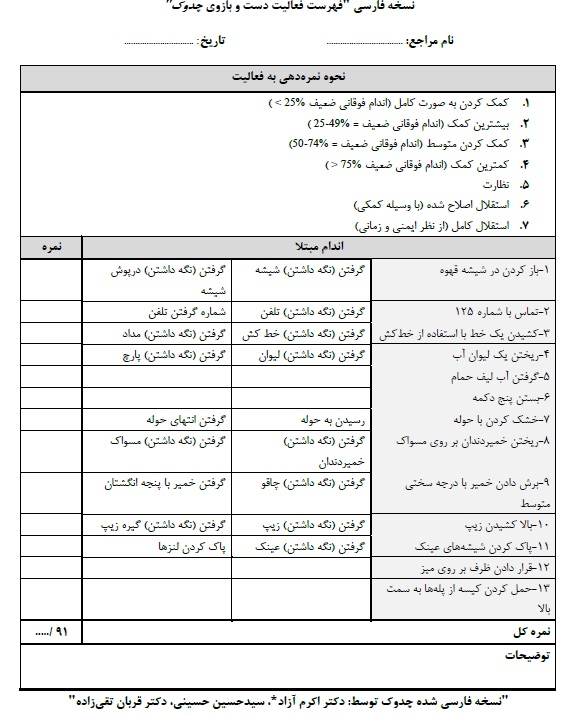
Appendix. Chedoke Arm and Hand Activity Inventory-13 (CAHAI-13)
Descriptive Statistics
A total of 105 stroke survivors participated in the present study. Their mean (SD) age was 65.89 (10.36) years, and the mean (SD) time since stroke onset was 18.65 (13.65) months. Fifty-eight participants (55.2%) were male, and 47 (44.8%) were female. In addition, 67 participants (63.8%) had right hemiplegia.
The mean (SD) CAHAI-13 score was 63.55 (22.11), with scores ranging from 15 to 91. The demographic characteristics of the study participants are presented in Table 1. Descriptive statistics for the assessment instruments used in the current study are presented in Table 2.
| Characteristics | N (%) | Mean (SD) | |
|---|---|---|---|
| Age | - | 65.89 (10.63) | |
| Month after onset | - | 18.65 (13.65) | |
| Mini-Mental State Examination | - | 26.67 (2.59) | |
| Gender | Female | 47 (44.8) | - |
| Male | 58 (55.2) | - | |
| Dominant hand | Right | 90 (85.7) | - |
| Left | 15 (14.3) | - | |
| Affected side | Right | 67 (63.8) | - |
| Left | 38 (36.2) | - | |
| Stroke type | Ischemic | 78 (74.3) | - |
| Hemorrhagic | 27 (25.7) | - | |
| Employment statues | unemployed | 35 (33.3) | - |
| Retired | 32 (30.5) | - | |
| Employed | 38 (36.2) | - | |
| Variables | Mean | Std. Deviation | Range |
|---|---|---|---|
| CAHAI | 63.55 | 21.11 | 15-91 |
| FMA-UE | 51.49 | 12.36 | 11-66 |
| WMFT | 50.88 | 19.79 | 7-75 |
| ARAT | 39.87 | 16.03 | 0-57 |
| FMA-UE Pain | 22.73 | 1.56 | 14-24 |
| CAHAI= Chedoke Arm and Hand Activity Inventory, FMA-UE= Fugl-Meyer Assessment Upper Extremity, WMFT= Wolf Motor Function Test, ARAT= Action Research Arm Test | |||
Validity
Table 3 presents the content validity results for the Persian version of the CAHAI-13. The Content Validity Ratio (CVR) values for all items were acceptable (0.70-1.00). In addition, the Content Validity Index (CVI) values for all items were satisfactory (0.83-1.00).
| Item | CVR | CVI (Simplicity) | CVI (Relevancy) | CVI (Clarity) | CVI (Total) |
|---|---|---|---|---|---|
| 1 | 1 | 1 | 1 | 1 | 1 |
| 2 | 0.8 | 1 | 0.8 | 0.9 | 0.83 |
| 3 | 0.8 | 1 | 1 | 1 | 1 |
| 4 | 1 | 1 | 1 | 1 | 1 |
| 5 | 0.8 | 1 | 1 | 0.9 | 0.97 |
| 6 | 1 | 1 | 1 | 1 | 1 |
| 7 | 0.8 | 1 | 1 | 1 | 1 |
| 8 | 0.7 | 1 | 1 | 1 | 1 |
| 9 | 0.7 | 1 | 0.9 | 1 | 0.97 |
| 10 | 1 | 1 | 1 | 1 | 1 |
| 11 | 0.7 | 1 | 1 | 1 | 1 |
| 12 | 1 | 1 | 1 | 1 | 1 |
| 13 | 1 | 1 | 1 | 1 | 1 |
| CVR= Content Validity Ratio, CVI= Content Validity Index | |||||
Exploratory factor analysis indicated that the study sample was adequate for factor analysis (KMO = 0.95; χ² = 384.065; P < 0.001). Principal component analysis showed that only one factor had an eigenvalue > 1, accounting for 66.37% of the total variance. The confirmatory factor analysis of the one-factor model is presented in Figure 1. All model fit indices (χ²/df = 1.27, GFI = 0.90, TLI = 0.98, NFI = 0.93, CFI = 0.98, and RMSEA = 0.05) indicated a good model fit, except for the AGFI (0.85), which was below the predetermined criterion of 0.90. Overall, the fit indices support the adequacy of the one-factor model in this population.
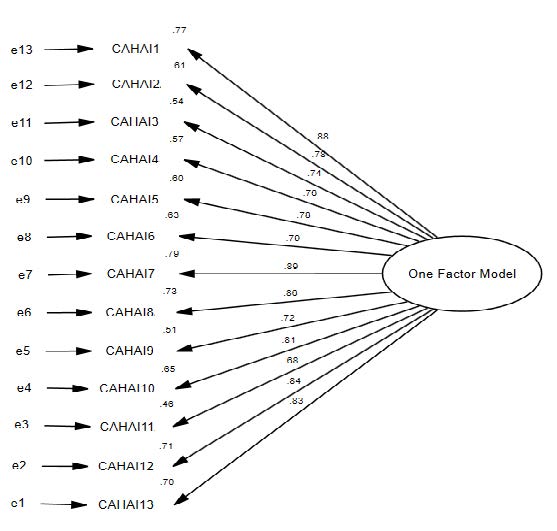
Figure 1. Confirmatory Factor Analysis of the Persian version of the Chedoke Arm and Hand Activity-13 (CAHAI-13) in Stroke survivors
The CAHAI-13 showed significant positive correlations with the ARAT (r = 0.84, P < 0.001), WMFT (r = 0.91, P < 0.001), and FMA-UE (r = 0.74, P < 0.001), supporting its convergent validity. For divergent validity, a significant weak positive correlation was observed between the CAHAI-13 and the pain domain of the FMA (r = 0.27, P < 0.001).
Table 4 presents the mean, SD, minimum, and maximum CAHAI-13 scores for participants with severe, moderate, and mild upper extremity impairment. The results showed that the CAHAI-13 scores differed significantly among the three groups (F = 123.36, P < 0.001). Post hoc multiple comparisons revealed that the CAHAI-13 significantly differentiated participants with severe upper extremity impairment from those with moderate impairment (t = 4.60, P < 0.001), participants with moderate impairment from those with mild impairment (t = 11.99, P < 0.001), and participants with severe impairment from those with mild impairment (t = 11.31, P < 0.001).
| Level of UE Impairment | No | Mean | Std. Deviation | Minimum | Maximum |
|---|---|---|---|---|---|
| 1 | 10 | 29.4 | 8.8 | 15.0 | 44.0 |
| 2 | 28 | 44.8 | 9.1 | 29.0 | 58.0 |
| 3 | 67 | 76.5 | 12.9 | 35.0 | 91.0 |
| Total | 105 | 63.5 | 21.1 | 15.0 | 91.0 |
Reliability
The results demonstrated that the CAHAI-13 had excellent internal consistency (Cronbach’s α = 0.96). Cronbach’s α ranged from 0.95 to 0.96 when individual items were deleted. The corrected item-total correlation coefficients ranged from 0.67 to 0.82.
The CAHAI-13 demonstrated good test-retest reliability (ICC = 0.85, 95% CI = 0.79-0.90) and excellent inter-rater reliability (ICC = 0.93, 95% CI = 0.87-0.97). The SEM and MDC90 values were 5.49 and 12.69, respectively. The floor and ceiling effects were 1.0% and 6.7%, respectively.
Discussion
The purpose of this study was to translate the CAHAI-13 into Persian and evaluate its psychometric properties in individuals with stroke. The results demonstrated that the Persian version of the CAHAI-13 is a valid and reliable instrument for evaluating upper-extremity function in chronic stroke survivors. An important consideration when selecting an assessment instrument is the availability of sound psychometric properties. Based on the experts’ evaluations of the CAHAI-13 items, this instrument is appropriate for assessing upper extremity function. Barreca et al. developed the CAHAI-13 using concepts such as the definition of upper extremity function, normative upper extremity movements, potential for functional change, the meaning of functional improvement for stroke survivors, and the contribution of the more affected upper extremity during bilateral tasks [ 11 ].
Additionally, the Persian version of the CAHAI-13 demonstrated satisfactory convergent and divergent validity. In this study, convergent validity was evaluated by examining the correlations between the CAHAI-13 and the ARAT, WMFT, and FMA-UE. The results showed that the CAHAI-13 had significant, strong positive correlations with all three instruments. The strongest correlation was observed with the WMFT, whereas the weakest correlation was found with the FMA-UE. This difference may be explained by the fact that both the CAHAI-13 and the WMFT assess upper extremity function during the performance of functional tasks, whereas the FMA-UE evaluates upper extremity function primarily through assessments of reflex activity and motor function [ 40 , 41 ].
The ARAT has been used in previous studies to examine the convergent validity of the CAHAI-13. The correlation between the ARAT and the CAHAI-13 was reported as 0.93, 0.80, and 0.59 in the original, Singaporean, and German versions, respectively [ 12 , 13 , 42 ]. The correlation observed in the present study was consistent with those reported for the original, Brazilian, and German versions of the CAHAI-13. The current findings were also consistent with those of the original and Singaporean versions but differed slightly from those of the German version. This discrepancy may be attributed to differences in the ARAT scoring procedure used in the German validation study [ 42 ].
The divergent validity results also indicated that the Persian version of the CAHAI-13 was able to distinguish between the constructs of pain and upper extremity function. Furthermore, the exploratory and confirmatory factor analyses supported a one-factor structure with an acceptable model fit in this population. This finding is consistent with the results reported in the original CAHAI-13 validation study [ 11 ].
For known-groups validity, participants were classified according to the severity of their upper extremity impairment based on their FMA-UE scores [ 34 ]. The results demonstrated that the Persian version of the CAHAI-13 was able to discriminate effectively among stroke survivors with severe, moderate, and mild upper extremity impairment. To our knowledge, this is the first study to evaluate the known-groups validity of the CAHAI-13.
The results demonstrated excellent internal consistency of the Persian version of the CAHAI-13. Adequate internal consistency indicates satisfactory homogeneity among the items used to assess upper extremity function in stroke survivors. This finding is consistent with those reported for the original (Cronbach’s α = 0.98), Brazilian (Cronbach’s α = 0.97), and German (Cronbach’s α = 0.97) versions of the CAHAI-13 [ 12 , 14 , 42 ].
The test-retest reliability of the Persian version of the CAHAI-13 was lower than that reported for the original version (ICC = 0.98). This difference may be attributed to the shorter interval (36 hours) between the test and retest assessments in the study by Barreca et al. [ 12 ]. Furthermore, the excellent inter-rater reliability observed in the present study is consistent with that reported for the original (ICC = 0.98), Singaporean (ICC = 0.97), Swiss (ICC = 0.99), and German (ICC = 0.99) versions of the CAHAI- 13[ 12 , 13 , 15 , 42 ].
The Standard Error of Measurement (SEM), another indicator of reliability, reflects measurement error [ 43 ]. The SEM value obtained in the present study was comparable to those reported for the Singaporean (4.8) and Indian (4.37) versions; however, it was higher than that reported for the original version (2.8) [ 12 , 13 , 16 ]. Although the SEM was less than half the standard deviation (the criterion for acceptable absolute reliability), the discrepancy relative to the original version may be attributable to differences in assessor training [ 44 ]. In the original study, training continued until the assessors achieved 85% agreement. In contrast, in the present study, the assessors received training, but no predefined criterion for agreement was established before the evaluations [ 12 ]. In addition, participants in the original study were classified by their upper-extremity function. This classification may have resulted in a smaller standard deviation than that observed in the Persian version of the CAHAI-13 [ 12 ].
The MDC value calculated in the present study may assist clinicians and researchers in identifying clinically meaningful changes in upper extremity function among chronic stroke survivors [ 45 ]. Moreover, the Persian version of the CAHAI-13 demonstrated acceptable floor and ceiling effects, supporting its suitability for evaluating upper extremity function in individuals with stroke.
Despite the strengths of the present study, including a relatively large sample size and the comprehensive evaluation of multiple psychometric properties, several limitations should be acknowledged. First, a non- probability sampling method was used, which may limit the generalizability of the findings. Second, no patient-reported outcome measures were included to assess upper extremity function. In addition to addressing these limitations, future studies should evaluate the responsiveness and minimal clinically important difference (MCID) of the CAHAI-13.
Another limitation of the present study is that the test-a single rater conducted retest reliability assessment. Although this approach was intended to minimize scoring variability, it may limit the generalizability of the reliability findings. To strengthen the evaluation of test-retest reliability, future studies are encouraged to include multiple raters.
Conclusions
The present study demonstrated that the Persian version of the CAHAI-13 has high content validity and shows appropriate associations with other upper extremity assessment instruments in individuals with stroke. In addition, the one-factor structure of the Persian version of the CAHAI-13 demonstrated an acceptable model fit. The instrument also showed satisfactory discriminative ability in distinguishing among individuals with varying levels of upper- extremity impairment. Furthermore, its excellent internal consistency, good test-retest reliability, and excellent inter-rater reliability support the reliability of the Persian version of the CAHAI-13.
Acknowledgment
The authors would like to express their sincere gratitude to all study participants for their valuable contributions and to the Iran University of Medical Sciences (IUMS) for its support. The authors also thank the original developers of the CAHAI, especially Mrs. Susan Barreca, for their support and assistance throughout the translation process.
Authors' Contributions
All authors read and approved the final version of the manuscript.
Funding
No funding was received for this study.
Conflict of Interest
The authors declare no conflicts of interest.
References
- Mozaffarian D, Benjamin EJ, Go AS, Arnett DK, Blaha MJ, Cushman M, et al. Heart disease and stroke statistics—2015 update: A report from the American Heart Association. Circulation. 2015; 131(4):e29-322.
- Johnson CO, Nguyen M, Roth GA, Nichols E, Alam T, Abate D, et al. Global, regional, and national burden of stroke, 1990- 2016: A systematic analysis for the Global Burden of Disease Study 2016. Lancet Neurol. 2019; 18(5):439-458.
- Persson HC. Upper extremity functioning during the first year after stroke. University of Gothenburg. 2015.
- Mandehgary-Najafabadi M, Azad A, Mehdizadeh H, Behzadipour S, Fakhar M, Taghavi Azar-Sharabiani P, et al. Improvement of upper limb motor control and function after competitive and noncompetitive volleyball exercises in chronic stroke survivors: A randomized clinical trial. Arch Phys Med Rehabil. 2019; 100(3):401-411.
- Nichols-Larsen DS, Clark PC, Zeringue A, Greenspan A, Blanton S. Factors influencing stroke survivors’ quality of life during subacute recovery. Stroke. 2005; 36(7):480-484.
- Langhorne P, Bernhardt J, Kwakkel G. Stroke rehabilitation. Lancet. 2011; 377(9778):1693-1702.
- Veerbeek JM, Kwakkel G, van Wegen EEH, Ket JCF, Heymans MW. Early prediction of outcome of activities of daily living after stroke: A systematic review. Stroke. 2011; 42(5):1482- 1488.
- Küçükdeveci A, Tennant A, Grimby G, Franchignoni F. Strategies for assessment and outcome measurement in physical and rehabilitation medicine: An educational review. J Rehabil Med. 2011; 43(8):661-672.
- Alt Murphy M, Resteghini C, Feys P, Lamers I. An overview of systematic reviews on upper extremity outcome measures after stroke. BMC Neurol. 2015; 15:1-15.
- Bailey RR, Klaesner JW, Lang CE. An accelerometry-based methodology for assessment of real-world bilateral upper extremity activity. PLoS One. 2014; 9(7):e103135.
- Barreca S, Gowland C, Stratford P, Huijbregts M, Griffiths J, Torresin W, et al. Development of the Chedoke Arm and Hand Activity Inventory: Theoretical constructs, item generation, and selection. Top Stroke Rehabil. 2004; 11(4):31-42.
- Barreca SR, Stratford PW, Lambert CL, Masters LM, Streiner DL. Test-retest reliability, validity, and sensitivity of the Chedoke Arm and Hand Activity Inventory: A new measure of upper-limb function for survivors of stroke. Arch Phys Med Rehabil. 2005; 86(8):1616-1622.
- Choo SX, Bosch J, Richardson J, Stratford P, Harris JE. Cross- cultural adaptation and psychometric evaluation of the Singapore version of the Chedoke Arm and Hand Activity. Disabil Rehabil. 2019; 41(21):2570-2577.
- Peres D, Romaguera F, Garcia JM, Rodrigues LC, Knabben RJ, Michaelsen SM. Cross-cultural adaptation of the Chedoke Arm and Hand Activity Inventory (CAHAI) 1. Cad Ter Ocup da UFSCar. 2017; 25(3):1-11.
- Schuster C, Hahn S, Ettlin T. Objectively-assessed outcome measures: A translation and cross-cultural adaptation procedure applied to the Chedoke McMaster Arm and Hand Activity Inventory (CAHAI). BMC Med Res Methodol. 2010; 10:1-9.
- Zaucha H, Thomas A. Utility of Chedoke Arm Hand Activity Inventory in the Indian population: Mixed method research sequential explanatory. Int J Res Med Sci. 2019; 7(6):2273.
- Arifin WN. A Web-based Sample Size Calculator for Reliability Studies. Educ Med J. 2018; 10(3):67-76.
- Tombaugh TN, McIntyre NJ. The mini‐mental state examination: A comprehensive review. J Am Geriatr Soc. 1992; 40(9):922-935.
- Bullinger M, Alonso J, Apolone G, Leplège A, Sullivan M, Wood-Dauphinee S, et al. Translating health status questionnaires and evaluating their quality: The IQOLA project approach. J Clin Epidemiol. 1998; 51(11):913-923.
- Azad A, Sabet A, Taghizadeh G, Mohammadi-Nezhad T. Clinical assessment of Persian translation of Fullerton Advanced Balance Scale in community-dwelling older adults. Disabil Rehabil. 2020; 42(4):567-573.
- Van der Lee JH, De Groot V, Beckerman H, Wagenaar RC, Lankhorst GJ, Bouter LM. The intra-and interrater reliability of the action research arm test: A practical test of upper extremity function in patients with stroke. Arch Phys Med Rehabil. 2001; 82(1):14-19.
- Hsieh CL, Hsueh IP, Chiang FM, Lin PH. Inter-rater reliability and validity of the Action Research Arm Test in stroke patients. Age Ageing. 1998; 27(2):107-113.
- Karimi E, Kalantary M, Shafiee Z, Tabatabaiee M. Inter-rater reliability of the Action Research Arm Test and the upper-limb section of Fugl-Meyer Test in adults with CVA who were resident in Qazvin, Iran. J Res Rehabil Sci. 2014; 10(1):67-76.
- Wolf SL, Catlin PA, Ellis M, Archer AL, Morgan B, Piacentino A. Assessing Wolf motor function test as outcome measure for research in patients after stroke. Stroke. 2001; 32(7):1635-1639.
- Morris DM, Uswatte G, Crago JE, Cook III EW, Taub E. The reliability of the Wolf Motor Function Test for assessing upper extremity function after stroke. Arch Phys Med Rehabil. 2001; 82(6):750-755.
- Deakin A, Hill H, Pomeroy VM. Rough guide to the Fugl-Meyer Assessment: Upper limb section. J Physiother. 2003; 89(12):751-763.
- Singer B, Garcia-Vega J. The Fugl-Meyer upper extremity scale. J Physiother. 2017; 63(1):53.
- Shrestha N. Factor analysis as a tool for survey analysis. Am J Appl Math Stat. 2021; 9(1):4-11.
- Arbuckle J. Amos 17.0 user’s guide. SPSS Inc.; 2008.
- Mulaik SA, James LR, Van Alstine J, Bennett N, Lind S, Stilwell CD. Evaluation of goodness-of-fit indices for structural equation models. Psychol Bull. 1989; 105(3):430.
- Bentler PM. Comparative fit indexes in structural models. Psychol Bull. 1990; 107(2):238.
- Fabrigar LR, Wegener DT, MacCallum RC, Strahan EJ. Evaluating the use of exploratory factor analysis in psychological research. Psychol Methods. 1999; 4(3):272.
- Mazaheri M, Salavati M, Negahban H, Sohani SM, Taghizadeh F, Feizi A, et al. Reliability and validity of the Persian version of Foot and Ankle Ability Measure (FAAM) to measure functional limitations in patients with foot and ankle disorders. Osteoarthr Cartil. 2010; 18(6):755-759.
- Woytowicz EJ, Rietschel JC, Goodman RN, Conroy SS, Sorkin JD, Whitall J, et al. Determining levels of upper extremity movement impairment by applying a cluster analysis to the Fugl- Meyer assessment of the upper extremity in chronic stroke. Arch Phys Med Rehabil. 2017; 98(3):456-462.
- Koo TK, Li MY. A Guideline of Selecting and Reporting Intraclass Correlation Coefficients for Reliability Research. J Chiropr Med. 2016; 15(2):155-163.
- Terwee CB, Bot SDM, de Boer MR, van der Windt DAWM, Knol DL, Dekker J, et al. Quality criteria were proposed for measurement properties of health status questionnaires. J Clin Epidemiol. 2007; 60(1):34-42.
- Atkinson G, Nevill AM. Statistical methods for assessing measurement error (reliability) in variables relevant to sports medicine. Sport Med. 1998; 26:217-238.
- DeVellis RF. Scale development: Theory and applications. Sage publications. Los Angeles, London, New Dehli, Singapore, Washingt DC, Melb. 2016.
- Sijtsma K. On the use, the misuse, and the very limited usefulness of Cronbach’s alpha. Psychometrika. 2009; 74:107-120.
- Berardi A, Tofani M, Valente D. Cross-cultural adaptation and validation in the Italian population of the Wolf Motor Function Test in patients with stroke. Funct Neurol. 2018; 33(4):229-253.
- Gladstone DJ, Danells CJ, Black SE. The Fugl-Meyer Assessment of motor recovery after stroke: A critical review of its measurement properties. Neurorehabil Neural Repair. 2002; 16(3):232-240.
- Behrendt F, Rizza JC, Blum F, Suica Z, Schuster-Amft C. German version of the Chedoke McMaster Arm and Hand Activity Inventory (CAHAI-G): Intra-rater reliability and responsiveness. Health Qual Life Outcomes. 2020; 18:1-9.
- Costa LOP, Maher CG, Latimer J, Hodges PW, Shirley D. An investigation of the reproducibility of ultrasound measures of abdominal muscle activation in patients with chronic non- specific low back pain. Eur Spine J. 2009; 18:1059-1065.
- Wyrwich KW, Nienaber NA, Tierney WM, Wolinsky FD. Linking clinical relevance and statistical significance in evaluating intra-individual changes in health-related quality of life. Med Care. 1999; 37(5):469-478.
- Lin K chung, Fu T, Wu C yi, Wang Y ho, Liu J sen, Hsieh C ju, et al. Minimal detectable change and clinically important difference of the Stroke Impact Scale in stroke patients. Neurorehabil Neural Repair. 2010; 24(5):486-492.


